


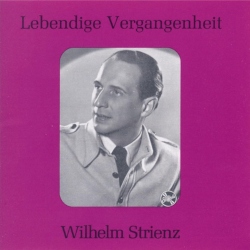
Wilhelm Strienz
Released Album
Opera
-
 September 14, 2018
 -
-
 February 1, 2005
 -
 December, 2000
 -
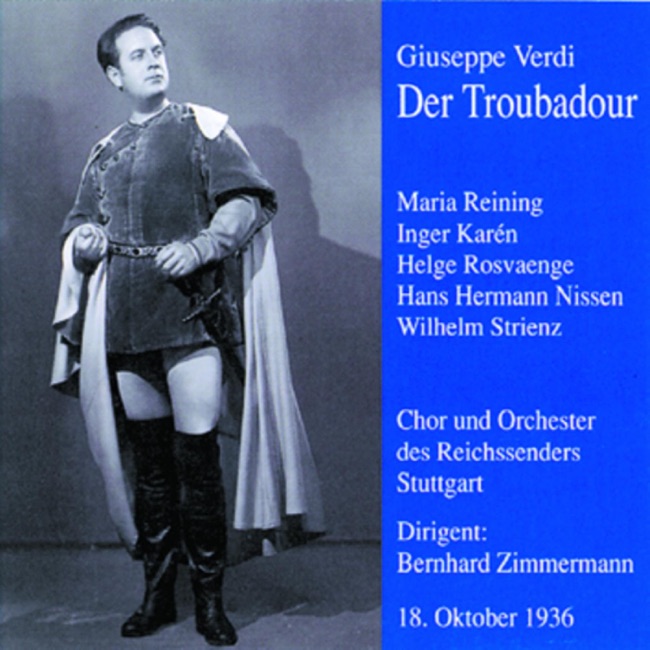 January 25, 2000
 -
 July 4, 1998
Artist Info
Period:ClassicalRomanticGenre:OperaWilhelm Strienz was a renowned German bass-baritone singer who was born on January 26, 1900, in the city of Berlin. He was the son of a music teacher and grew up in a musical family. Strienz showed an early interest in music and began singing in choirs at a young age. He received his formal music education at the Berlin Conservatory, where he studied under the tutelage of the famous German baritone, Julius von Raatz-Brockmann. Strienz made his professional debut in 1923 at the Berlin State Opera, where he performed the role of the Night Watchman in Richard Wagner's "Die Meistersinger von Nürnberg." He quickly gained recognition for his powerful voice and his ability to convey emotion through his singing. Strienz's career took off, and he became one of the most sought-after bass-baritones of his time. In 1925, Strienz joined the Berlin State Opera as a permanent member, where he performed in a variety of roles, including the title role in Mozart's "Don Giovanni," Sarastro in "The Magic Flute," and King Marke in Wagner's "Tristan und Isolde." He also performed in other major opera houses throughout Europe, including the Vienna State Opera, the Royal Opera House in London, and the Paris Opera. One of Strienz's most notable performances was in 1936 when he sang the role of Christus in Johann Sebastian Bach's "St. Matthew Passion" at the Berlin Cathedral. The performance was attended by Adolf Hitler and other high-ranking Nazi officials, and it was broadcast throughout Germany. Strienz's performance was widely praised, and he became known as the "voice of the Third Reich." Despite his popularity, Strienz was not a member of the Nazi Party and did not support their ideology. He was, however, forced to perform for the Nazi regime, and his career suffered as a result. After World War II, Strienz was banned from performing for several years, but he eventually returned to the stage in 1949. In the years following the war, Strienz continued to perform in operas and concerts throughout Europe. He also made several recordings, including a series of lieder by Franz Schubert and Robert Schumann. Strienz's recordings were highly regarded, and he was praised for his ability to convey the emotion and meaning of the songs. In 1955, Strienz was awarded the title of Kammersänger by the West German government in recognition of his contributions to the arts. He continued to perform until his retirement in 1966, after which he devoted his time to teaching and mentoring young singers. Wilhelm Strienz died on April 10, 1987, at the age of 87. He is remembered as one of the greatest bass-baritones of the 20th century, known for his powerful voice, emotional performances, and contributions to the world of classical music.More....
Recent Artist Music
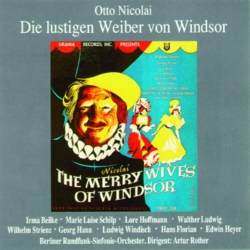
8
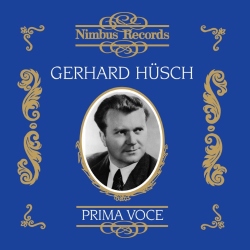
The Troubadour
Alles ist stille... Ihres Auges himmlisch'... Was hör' ich... O dürft' ich es glauben (Tutto è dese
8:15
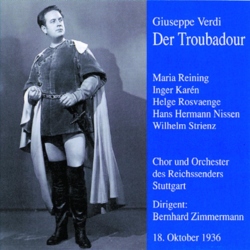

11
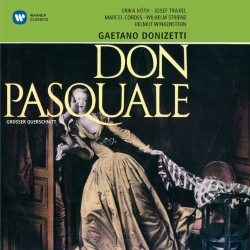
Don Pasquale
Act 1 Scene 5: No. 5, Kavatine, 'O diese Glut in Blicken … Auch ich versteh' die feine Kunst'
5:58
Related Artists
Copyright Ⓒ 2013 Davinci Finger. All rights reseved
Service Terms & Policy