


Wolfgang Amadeus Mozart
Preludes and fugues (6) (after J. S. and W. F. Bach), K. 404a
Released Album
Recent Album
Works Info
Composer:Wolfgang Amadeus MozartGenre:KeyboardStyle:Prelude & FugueCompose Date:1782Average_duration:45:12Movement_count:6Movement ....Wolfgang Amadeus Mozart composed the "Preludes and Fugues (6) (after J. S. and W. F. Bach), K. 404a" in 1782. The work was not premiered during Mozart's lifetime, and it was not until 1802 that the first edition was published by Breitkopf & Härtel in Leipzig. The work consists of six preludes and fugues, each based on a theme by either Johann Sebastian Bach or his son, Wilhelm Friedemann Bach. The first prelude and fugue are based on a theme by J. S. Bach, while the second, third, and fourth are based on themes by W. F. Bach. The fifth prelude and fugue are based on a theme by J. S. Bach, and the final prelude and fugue are based on a theme by W. F. Bach. The preludes are short, improvisatory pieces that serve as an introduction to the fugues. They are characterized by their virtuosic keyboard writing and their use of ornamentation. The fugues, on the other hand, are more complex and structured pieces that showcase Mozart's contrapuntal skills. They are characterized by their use of imitation, where one voice introduces a theme and is then imitated by the other voices. The first prelude and fugue are in the key of C major and are based on a theme from J. S. Bach's "Well-Tempered Clavier." The prelude is a lively and virtuosic piece that features rapid arpeggios and scales. The fugue is a four-voice piece that is characterized by its use of stretto, where the voices enter one after the other in quick succession. The second prelude and fugue are in the key of G major and are based on a theme by W. F. Bach. The prelude is a slower and more contemplative piece that features a lyrical melody. The fugue is a three-voice piece that is characterized by its use of syncopation and its lively, dance-like rhythm. The third prelude and fugue are in the key of D minor and are based on a theme by W. F. Bach. The prelude is a fast and virtuosic piece that features rapid runs and arpeggios. The fugue is a four-voice piece that is characterized by its use of chromaticism and its dramatic, intense mood. The fourth prelude and fugue are in the key of F major and are based on a theme by W. F. Bach. The prelude is a lively and playful piece that features a bouncy rhythm. The fugue is a three-voice piece that is characterized by its use of imitation and its light, cheerful mood. The fifth prelude and fugue are in the key of E minor and are based on a theme from J. S. Bach's "Well-Tempered Clavier." The prelude is a slow and melancholic piece that features a haunting melody. The fugue is a four-voice piece that is characterized by its use of inversion, where the theme is played upside down. The final prelude and fugue are in the key of A major and are based on a theme by W. F. Bach. The prelude is a fast and virtuosic piece that features rapid runs and arpeggios. The fugue is a three-voice piece that is characterized by its use of imitation and its lively, dance-like rhythm. Overall, the "Preludes and Fugues (6) (after J. S. and W. F. Bach), K. 404a" is a virtuosic and complex work that showcases Mozart's contrapuntal skills. The use of themes by J. S. and W. F.More....
Works Music
Released Music
2
10:2
3
4:10
4
4:11
5
5:
6
4:26
7
3:58
8
3:55
9
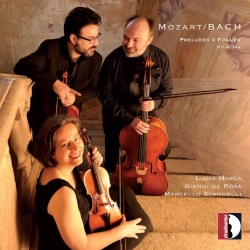
Preludes and fugues (6) (after JS and WF Bach), K. 404a
Adagio e Fuga n. 1 in re minore~Adagio
4:28
10
3:52
Main Perform Artists
Violin
Viola
Cello
Violin
Viola
Cello