


Havergal Brian
Released Album
Symphony
-
 March 17, 2023
 -
-
 October 13, 2017
 -
 March 5, 2016
 -
 April 14, 2015
 -
 March 10, 2015
Orchestral
Choral
-
 November 28, 2011
 -
 January 30, 2007
 -
 June 20, 2003
 -
 December 17, 1992
Artist Info
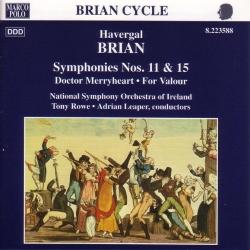
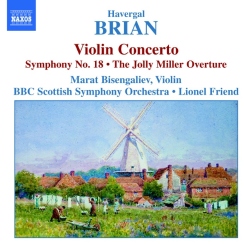
Role:ComposerCountry: United KingdomBirth:January 29, 1876 in Dresden, Staffordshire, EnglandDeath:November 28, 1972 in Shoreham-by-Sea, Sussex, EnglandPeriod:ModernGenre:ChoralKeyboardOrchestralSymphonyHavergal Brian was a British composer who lived from 1876 to 1972. He was born in Dresden, Germany, to English parents, and spent most of his life in England. Brian was a prolific composer, producing over 80 works in a variety of genres, including symphonies, operas, chamber music, and choral works. Despite his prolific output, Brian's music was largely ignored during his lifetime, and it was only in the years following his death that his work began to receive the recognition it deserved. Brian's early years were marked by a love of music and a talent for composition. He began composing at a young age, and by the time he was a teenager, he had already written several works for piano and chamber ensembles. However, his parents did not support his musical ambitions, and instead encouraged him to pursue a career in engineering. Brian worked as an engineer for several years, but he continued to compose in his spare time. In 1907, Brian's life took a dramatic turn when he won a large sum of money in a lottery. With this windfall, he was able to quit his job and devote himself full-time to music. He moved to London and began studying composition with Charles Villiers Stanford at the Royal College of Music. During this time, Brian wrote several works that would later become part of his mature output, including his first symphony, "The Gothic." "The Gothic" is one of Brian's most famous works, and it is also one of the longest symphonies ever written. The piece is scored for a massive orchestra, multiple choirs, and an organ, and it lasts over two hours. The symphony is divided into two parts, each of which is further divided into multiple sections. The piece is notable for its use of unconventional instruments, such as a wind machine and a siren, and for its complex polyphonic textures. Despite its length and complexity, "The Gothic" was well-received at its premiere in 1913. However, the piece was not performed again until 1961, when it was revived by the conductor Myer Fredman. Since then, "The Gothic" has become one of Brian's most frequently performed works, and it is considered a masterpiece of 20th-century music. In addition to "The Gothic," Brian wrote 31 other symphonies, making him one of the most prolific symphonists in history. His symphonies are notable for their unconventional structures, complex harmonies, and use of unusual instruments. Many of Brian's symphonies were inspired by literary or historical themes, such as his second symphony, "The Four Seasons," which is based on the poems of John Clare, and his third symphony, "The Gothic," which is inspired by the medieval cathedral. Brian's operas are also notable for their unconventional structures and subject matter. His most famous opera, "The Tigers," is a surrealistic work that tells the story of a group of tigers who rebel against their human oppressors. The opera is scored for a large orchestra and features a chorus of tigers, as well as a solo soprano who sings the role of the tiger queen. "The Tigers" was never performed during Brian's lifetime, but it has since been revived and recorded several times. Despite his prolific output, Brian's music was largely ignored during his lifetime. He was never able to secure a regular position as a composer or conductor, and he struggled financially for much of his life. However, in the years following his death, Brian's music began to receive the recognition it deserved.More....
Recent Artist Music
3
2:33


12
19:43

Copyright Ⓒ 2013 Davinci Finger. All rights reseved
Service Terms & Policy