


Iannis Xenakis
Released Album
Chamber
-
 September 11, 2024
 -
 December 1, 2023
 -
 September 7, 2022
 -
-
-
 May 6, 2022
Keyboard
-
 March 26, 2021
 -
 December 1, 2016
 -
 August 5, 2016
 -
 May 12, 2015
 -
 February 13, 2012
 -
Orchestral
-
 December 2, 2022
 -
 May 27, 2022
 -
 October 27, 2017
 -
 July 21, 2009
 -
 June 30, 2009
 -
 February 24, 2009
Choral
-
 October 14, 2016
 -
 February 26, 2016
 -
 May 11, 2015
 -
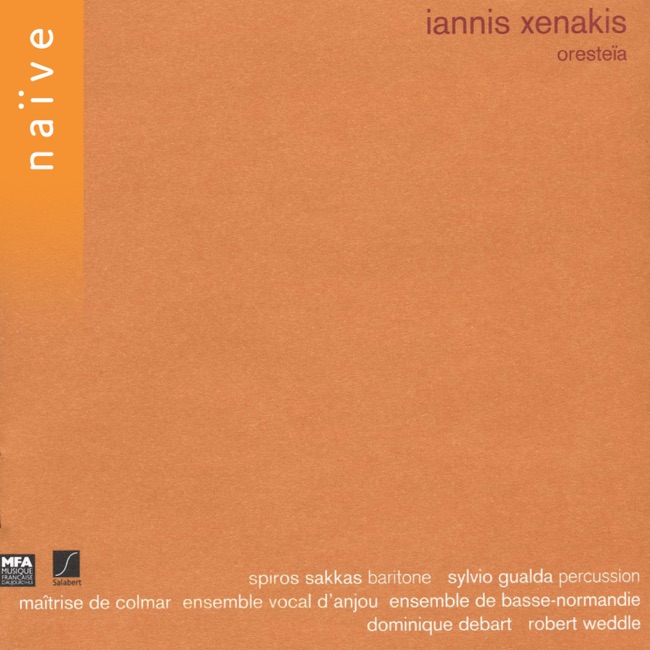 July 9, 2002
 -
 September 25, 2001
 -

Artist Info
Role:Composer PerformerCountry: GreeceBirth:May 29, 1922 in Braïla, RomaniaDeath:February 4, 2001 in Paris, FrancePeriod:ContemporaryGenre:Avant-GardeChamberOrchestralIannis Xenakis was a Greek-French composer, architect, and mathematician who is widely regarded as one of the most important figures in 20th-century music. Born on May 29, 1922, in Brăila, Romania, Xenakis spent his early years in Greece before moving to France in 1947. He died on February 4, 2001, in Paris, France. Xenakis was born to Greek parents who had fled to Romania during the Greco-Turkish War. His father was a businessman, and his mother was a pianist. Xenakis showed an early interest in music and began taking piano lessons at the age of six. However, his formal musical education was interrupted by World War II, during which he fought as a member of the Greek Resistance. After the war, Xenakis moved to Athens, where he studied engineering and mathematics at the National Technical University of Athens. He also began studying music with the composer and conductor Dimitri Mitropoulos. In 1947, Xenakis moved to Paris to study with the composer Olivier Messiaen at the Conservatoire de Paris. Xenakis's early works were heavily influenced by his interest in mathematics and architecture. He developed a unique approach to composition that involved using mathematical models to generate musical structures. His first major work, Metastasis, was composed in 1953 and is considered a landmark in the development of electronic music. The piece was created using a mathematical model of Brownian motion, which Xenakis used to generate a series of sound events that were then recorded and manipulated using tape machines. In the late 1950s, Xenakis began to incorporate elements of Greek folk music into his compositions. He also began to experiment with new forms of notation, including graphic notation, which allowed him to create complex and unconventional musical structures. One of his most famous works from this period is Pithoprakta, which was composed in 1955 and is scored for string orchestra and percussion. The piece is characterized by its use of complex rhythmic patterns and its unconventional notation. In the 1960s, Xenakis began to explore the use of computer technology in music composition. He worked with the computer scientist Iannis Vlachos to develop a program called UPIC (Unité Polyagogique Informatique du CEMAMu), which allowed composers to create music using a graphical interface. Xenakis used UPIC to create a number of works, including Mycènes Alpha, which was composed in 1978 and is scored for 12 instruments and computer-generated sounds. Xenakis's later works continued to explore the intersection of mathematics, architecture, and music. He created a number of large-scale works for orchestra and choir, including Oresteia, which was composed in 1965 and is based on the ancient Greek tragedy by Aeschylus. He also continued to experiment with new forms of notation, including stochastic notation, which allowed him to create music that was partially determined by chance. Xenakis's contributions to music were recognized with numerous awards and honors. He was awarded the Kyoto Prize in 1997, and he was made a member of the French Legion of Honor in 1985. He also received honorary doctorates from a number of universities, including the University of Paris and the University of Edinburgh. In addition to his work as a composer, Xenakis was also a respected architect and mathematician.More....









Copyright Ⓒ 2013 Davinci Finger. All rights reseved
Service Terms & Policy