Iannis Xenakis
Metastasis
Released Album
Recent Album
Featured Album
Works Info
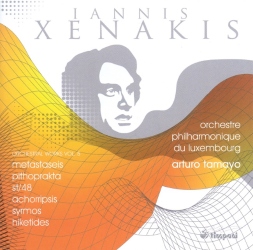
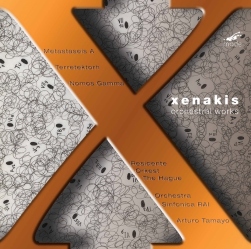
Composer:Iannis XenakisGenre:OrchestralStyle:Open FormCompose Date:1953 - 1954Average_duration:8:19Metastasis is a composition by the Greek-French composer Iannis Xenakis. It was composed in 1953 and premiered on October 4, 1954, at the Donaueschingen Festival in Germany. The piece is considered one of the most important works of the 20th century avant-garde music. Metastasis is a piece for 61 musicians, including strings, brass, woodwinds, and percussion. The composition is divided into four movements, each with its own distinct character. The first movement is characterized by a slow, ominous introduction, which gradually builds in intensity and complexity. The second movement is more frenetic, with rapid, staccato rhythms and dissonant harmonies. The third movement is more contemplative, with long, sustained notes and a sense of stillness. The final movement is a return to the frenetic energy of the second movement, with a sense of urgency and tension building to a climactic finish. One of the most striking characteristics of Metastasis is its use of microtonal intervals. Xenakis was interested in exploring the possibilities of sound beyond the traditional Western tonal system, and he used a system of microtonal intervals to create a unique and otherworldly sound. The piece also features complex rhythms and polyrhythms, with different instruments playing in different time signatures simultaneously. Metastasis is often cited as an example of Xenakis's interest in mathematical and scientific principles in music. The composer was trained as an engineer and mathematician, and he used his knowledge of these fields to create complex and innovative musical structures. The piece is also notable for its use of graphic notation, which allows the performers to interpret the score in their own way and create a unique performance each time the piece is played. Overall, Metastasis is a groundbreaking work that pushed the boundaries of what was possible in music. Its use of microtonal intervals, complex rhythms, and graphic notation paved the way for future generations of avant-garde composers.More....