


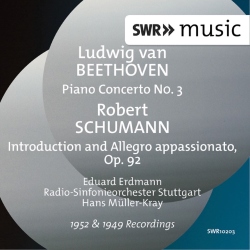
Eduard Erdmann
Released Album
Keyboard
-
-
-
 January 1, 2018
 -
-
-
 April 12, 2007
Concerto
Chamber
-
-
 July 17, 2020
 -
Symphony
-
 November 15, 2005
Artist Info
Role:ComposerCountry: GermanyBirth:March 18, 1896 in Wenden, LatviaDeath:June 21, 1958 in Hamburg, GermanyPeriod:ClassicalRomanticModernGenre:ConcertoKeyboardOrchestralSymphonyEduard Erdmann was a German pianist and composer who was born on January 13, 1896, in Berlin, Germany. He was the son of a well-known music teacher and composer, Heinrich Eduard Erdmann, who was also his first piano teacher. Erdmann showed an early talent for music and began performing in public at the age of nine. Erdmann studied at the Berlin Hochschule für Musik with the renowned pianist and teacher, Martin Krause. He also studied composition with Paul Juon and Max Bruch. Erdmann's talent as a pianist was recognized early on, and he won several prizes and awards for his performances. In 1914, Erdmann made his debut as a soloist with the Berlin Philharmonic Orchestra, playing Beethoven's Piano Concerto No. 4. He went on to perform with many other orchestras throughout Europe, including the London Symphony Orchestra, the Vienna Philharmonic, and the Amsterdam Concertgebouw Orchestra. Erdmann was known for his virtuosic playing and his ability to bring out the emotional depth of the music he played. He was particularly admired for his interpretations of the works of Beethoven, Schumann, and Brahms. During World War I, Erdmann served in the German army, but he continued to perform whenever he could. After the war, he resumed his career as a pianist and composer. He also became a teacher, and his students included the pianist and composer Hans Werner Henze. In 1928, Erdmann made his first tour of the United States, where he was warmly received by audiences and critics alike. He returned to the U.S. several times over the next few years, performing in major cities such as New York, Boston, and Chicago. Erdmann was also a prolific composer, and his works include piano pieces, chamber music, and orchestral works. His music is characterized by its lyricism and emotional intensity, and it shows the influence of composers such as Schumann and Brahms. In 1933, Erdmann's career was interrupted by the rise of the Nazi regime in Germany. As a Jew, he was no longer allowed to perform in public, and his music was banned. Erdmann and his wife, the pianist Gertrud Meyer-Denkmann, fled to Switzerland, where they lived for several years. In 1938, Erdmann and Meyer-Denkmann emigrated to the United States, where they settled in New York City. Erdmann continued to compose and teach, but he did not perform in public again until after World War II. In 1949, Erdmann made a triumphant return to the concert stage, performing in Europe and the United States. He continued to perform and teach until his death on December 24, 1958, in New York City. Erdmann's legacy as a pianist and composer is still celebrated today. His recordings are prized by collectors, and his music continues to be performed and recorded by musicians around the world. He is remembered as a musician of great sensitivity and depth, whose artistry touched the hearts of audiences everywhere he played.More....
Recent Artist Music
3
13:1
7
8:24
9
14:23
10
11:31
Copyright Ⓒ 2013 Davinci Finger. All rights reseved
Service Terms & Policy