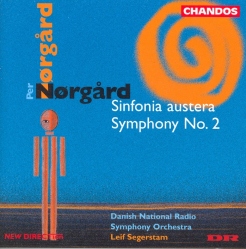
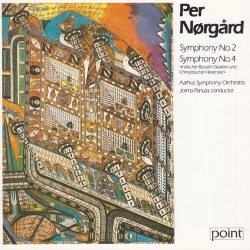
Per Nørgård
Symphony No. 2
Released Album
Recent Album
Featured Album
Works Info
Composer:Per NørgårdGenre:SymphonyStyle:SymphonyCompose Date:1970Average_duration:22:22Symphony No. 2, also known as "The Oceanic," is a composition by Danish composer Per Nørgård. It was composed between 1970 and 1971 and premiered on September 23, 1972, by the Danish National Symphony Orchestra conducted by John Frandsen. The symphony is divided into four movements, each with its own distinct character. The first movement, "The Sea," is characterized by its fluidity and undulating rhythms, evoking the ebb and flow of the ocean. The second movement, "The Waves," is more turbulent and agitated, with crashing percussion and dissonant harmonies. The third movement, "The Currents," is more introspective, with a slower tempo and a sense of contemplation. The final movement, "The Abyss," is the most dramatic and intense, with a sense of impending doom and a powerful climax. One of the most notable characteristics of Symphony No. 2 is Nørgård's use of the "infinity series," a compositional technique he developed in the 1960s. The infinity series is a mathematical sequence of numbers that can be used to generate an infinite number of melodies and harmonies. Nørgård uses this technique throughout the symphony, creating a sense of unity and coherence across the four movements. Another notable characteristic of Symphony No. 2 is its use of unconventional instrumentation. In addition to the standard orchestra, Nørgård includes a variety of percussion instruments, including maracas, bongos, and congas, as well as a synthesizer and a tape recorder. These unconventional instruments add to the symphony's otherworldly and oceanic atmosphere. Overall, Symphony No. 2 is a powerful and evocative work that showcases Nørgård's innovative compositional techniques and his ability to create a sense of unity and coherence across multiple movements. Its use of unconventional instrumentation and its evocation of the ocean make it a unique and memorable addition to the symphonic repertoire.More....