


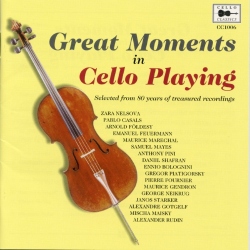
Maurice Maréchal
Released Album
Chamber
-
 October 13, 2005
 -
 November 30, 2001
Artist Info
Role:ComposerCountry: FranceBirth:1892Death:1964 in Dijon, FrancePeriod:BaroqueModernGenre:ChamberConcertoMaurice Maréchal was a French cellist and conductor who made significant contributions to the world of classical music during the early 20th century. Born on May 22, 1892, in Lille, France, Maréchal showed an early interest in music and began playing the cello at the age of six. He received his formal training at the Paris Conservatory, where he studied under the renowned cellist Jules Leopold Loeb. Maréchal's talent as a cellist quickly became apparent, and he began performing professionally at a young age. In 1911, he joined the orchestra of the Paris Opera, where he played under the direction of some of the most prominent conductors of the time, including Gustav Mahler and Richard Strauss. He also performed as a soloist, giving concerts throughout Europe and the United States. One of Maréchal's most significant achievements as a cellist was his collaboration with the composer Maurice Ravel. In 1922, Ravel wrote his Sonata for Violin and Cello, which he dedicated to Maréchal and the violinist Hélène Jourdan-Morhange. The piece was premiered by the two musicians in Paris in 1922 and was later performed by them in London and New York. Maréchal's interpretation of the cello part was widely praised, and the piece has since become a staple of the cello repertoire. In addition to his work as a cellist, Maréchal was also an accomplished conductor. He founded the Orchestre des Concerts Colonne in 1934 and served as its principal conductor until 1944. He also conducted the Orchestre National de France and the Orchestre de la Société des Concerts du Conservatoire, among others. His conducting style was characterized by a meticulous attention to detail and a deep understanding of the music he was conducting. Maréchal's career was interrupted by the outbreak of World War II. He was drafted into the French army in 1939 and served as a medic until he was captured by the Germans in 1940. He spent the next five years as a prisoner of war, during which time he continued to play the cello and organize musical performances for his fellow prisoners. He was liberated in 1945 and returned to France, where he resumed his career as a cellist and conductor. One of Maréchal's most memorable performances took place in 1955, when he played the cello solo in Camille Saint-Saëns' Cello Concerto No. 1 with the Orchestre National de France. The performance was recorded and has since become a classic of the cello repertoire. Maréchal's interpretation of the piece is characterized by a warm, lyrical tone and a deep emotional intensity. Maréchal received numerous awards and honors throughout his career. In 1935, he was awarded the Legion of Honor, one of France's highest honors. He was also awarded the Grand Prix du Disque for his recording of the Ravel Sonata in 1953. In 1962, he was awarded the Grand Prix National de la Musique, the highest honor for a musician in France. Maréchal continued to perform and conduct until his death on April 17, 1964, in Paris. He left behind a legacy as one of the most accomplished cellists and conductors of his time, and his contributions to the world of classical music continue to be celebrated today.More....


Copyright Ⓒ 2013 Davinci Finger. All rights reseved
Service Terms & Policy