


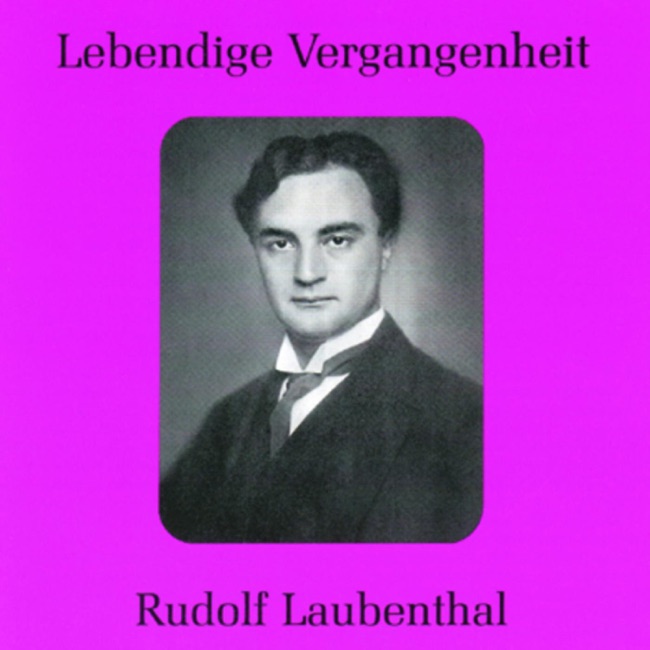
Rudolf Laubenthal
Released Album
Opera
-
 March 29, 2005
 -
Artist Info
Rudolf Laubenthal was a renowned German tenor who made a significant contribution to the world of classical music during the early 20th century. Born on January 2, 1879, in Berlin, Germany, Laubenthal was the son of a well-known opera singer, Gustav Laubenthal. His father's profession inspired him to pursue a career in music, and he began his training at the Berlin Conservatory at the age of 18. Laubenthal's early years were marked by a series of successes, including his debut performance at the Berlin State Opera in 1902. He quickly gained recognition for his powerful voice and his ability to convey emotion through his performances. In 1904, he was invited to perform at the Bayreuth Festival, where he sang the role of Walther von Stolzing in Richard Wagner's "Die Meistersinger von Nürnberg." This performance was a turning point in Laubenthal's career, as it established him as one of the leading tenors of his time. Over the next few years, Laubenthal continued to perform in some of the most prestigious opera houses in Europe, including the Vienna State Opera, the Royal Opera House in London, and the Paris Opera. He also made several appearances in the United States, where he was well-received by audiences and critics alike. One of Laubenthal's most notable performances was his portrayal of the title character in Richard Strauss's "Salome" at the Dresden State Opera in 1907. This performance was particularly significant because it marked the first time that the opera had been performed in Germany. Laubenthal's interpretation of the role was widely praised, and it helped to establish "Salome" as one of the most important operas of the 20th century. In addition to his work in opera, Laubenthal was also a prolific concert singer. He performed in numerous concerts throughout Europe and the United States, and he was particularly well-known for his interpretations of the works of Bach, Beethoven, and Schubert. He also recorded several albums of classical music, which were widely popular among music lovers. Despite his many successes, Laubenthal's career was not without its challenges. He suffered from health problems throughout his life, and he was forced to take extended breaks from performing on several occasions. Additionally, the outbreak of World War I in 1914 disrupted his career, as many of the opera houses where he had performed were closed or destroyed. Despite these setbacks, Laubenthal continued to perform throughout the war years and into the 1920s. He made several appearances at the Metropolitan Opera in New York City, where he was a favorite of audiences and critics alike. He also continued to perform in Europe, where he was particularly well-received in his native Germany. One of Laubenthal's most significant achievements was his role in the establishment of the Salzburg Festival in Austria. In 1920, he was invited to perform at the festival's inaugural season, where he sang the role of Don Ottavio in Mozart's "Don Giovanni." Laubenthal's performance was widely praised, and he became a regular performer at the festival in the years that followed. He also played a key role in the festival's development, serving as a member of its artistic committee and helping to shape its programming. Laubenthal's career began to wind down in the late 1920s, as his health problems became more severe. He made his final appearance on stage in 1930, singing the role of Florestan in Beethoven's "Fidelio" at the Berlin State Opera.More....
Copyright Ⓒ 2013 Davinci Finger. All rights reseved
Service Terms & Policy