


Carl Friedrich Zelter
Released Album
Vocal
-
 January 15, 2021
 -
 April 3, 2020
 -
 January 1, 2016
 -
 October 10, 2010
 -
 March 29, 2005
 -
 January 1, 1999
Concerto
-
 February 14, 2006
Choral
-
 August 19, 2008
 -
Artist Info
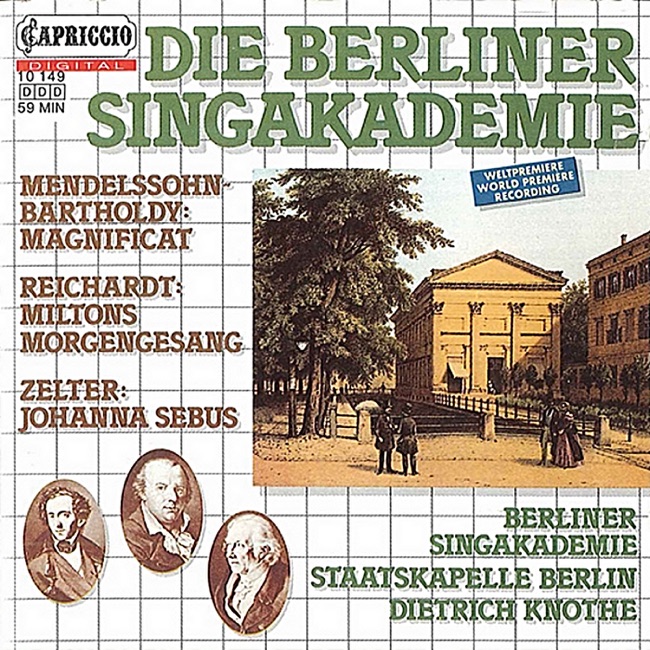
Role:ComposerCountry: GermanyBirth:December 11, 1758 in Berlin, GermanyDeath:May 15, 1832 in Berlin, GermanyPeriod:RomanticGenre:VocalCarl Friedrich Zelter was a German composer, conductor, and teacher who lived from December 11, 1758, to May 15, 1832. He was born in Berlin, Germany, to a family of musicians. His father, Johann Carl Gottfried Zelter, was a musician and instrument maker, and his mother, Johanna Sophia, was a singer. Zelter showed an early interest in music and began studying the violin and keyboard at a young age. Zelter's musical education began at the Berlin Singakademie, where he studied under the composer and conductor Carl Friedrich Christian Fasch. He later studied with Johann Philipp Kirnberger, a student of Johann Sebastian Bach. Zelter's studies with Kirnberger were particularly influential, as Kirnberger was a leading authority on Bach's music and taught Zelter the principles of counterpoint and harmony. In 1783, Zelter became the conductor of the Berlin Singakademie, a position he held for the rest of his life. Under his leadership, the Singakademie became one of the most important musical institutions in Germany, and Zelter became known as one of the leading conductors of his time. Zelter was also a prolific composer, although his works are not as well-known as those of some of his contemporaries. He composed in a variety of genres, including choral music, chamber music, and opera. His choral music is particularly noteworthy, and he is considered one of the most important composers of choral music in Germany during the late 18th and early 19th centuries. One of Zelter's most famous works is his setting of Goethe's poem "An die Musik" ("To Music"). The piece is a tribute to the power of music and has become one of the most beloved songs in the German language. Zelter's other notable works include his opera "Medea," his "Lieder" (songs), and his "Streichquartette" (string quartets). In addition to his work as a composer and conductor, Zelter was also a respected teacher. He taught at the Berlin Singakademie and at the Royal Academy of Music in Berlin, where his students included Felix Mendelssohn and Giacomo Meyerbeer. Mendelssohn was particularly influenced by Zelter, and the two became close friends. Mendelssohn later wrote a tribute to Zelter, calling him "the most excellent and noble of men." Zelter's legacy as a composer and conductor has been somewhat overshadowed by the achievements of his more famous contemporaries, such as Mozart, Beethoven, and Haydn. However, his contributions to the development of choral music in Germany and his influence on the next generation of composers, including Mendelssohn, cannot be overstated. Zelter's music continues to be performed and studied today, and his legacy as a teacher and mentor to some of the greatest composers of the 19th century remains an important part of the history of classical music.More....
Recent Artist Music
7
8:39


13
5:16
14
1:51

Copyright Ⓒ 2013 Davinci Finger. All rights reseved
Service Terms & Policy