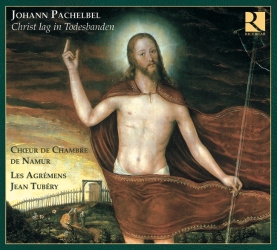
Johann Pachelbel
Christ lag in Todesbanden, T. 371
Released Album
Recent Album
-
-
 Various ArtistsAugust 1, 2004
 -
-
Works Info
Composer:Johann PachelbelGenre:ChoralStyle:ChoralCompose Date:before Apr 1706Publication Date:1988Average_duration:12:56Johann Pachelbel's "Christ lag in Todesbanden, T. 371" is a sacred cantata that was composed in the late 17th century. The piece is based on a Lutheran hymn of the same name, which translates to "Christ lay in death's bonds." The cantata is written for four voices (soprano, alto, tenor, and bass) and a small instrumental ensemble consisting of two violins, viola, and continuo. The piece is divided into eight movements, each of which corresponds to a verse of the hymn. The first movement is a sinfonia, or instrumental introduction, that sets the tone for the piece with its somber, mournful melody. The second movement features the soprano soloist singing the first verse of the hymn, accompanied by the continuo. The third movement is a duet between the alto and tenor, who sing the second verse of the hymn. The fourth movement is a trio for the soprano, alto, and tenor, who sing the third verse of the hymn. The fifth movement is a solo for the bass, who sings the fourth verse of the hymn. The sixth movement is a duet for the soprano and alto, who sing the fifth verse of the hymn. The seventh movement is a trio for the tenor, bass, and continuo, who sing the sixth verse of the hymn. The final movement is a chorale, in which all four voices sing the seventh verse of the hymn in unison. One of the most notable characteristics of "Christ lag in Todesbanden" is its use of chromaticism, or the use of notes outside of the diatonic scale. This gives the piece a sense of tension and unease, which is appropriate for a piece about death and resurrection. Another characteristic of the piece is its use of imitative counterpoint, in which the different voices echo and imitate each other's melodies. "Christ lag in Todesbanden" was likely composed in the early 1680s, during Pachelbel's time as organist at the Predigerkirche in Erfurt, Germany. The piece was premiered in Erfurt, and it quickly became popular throughout Germany and beyond. Today, it is considered one of Pachelbel's most important works, and it is still frequently performed and recorded.More....
Works Music
Released Music