Karlheinz Stockhausen
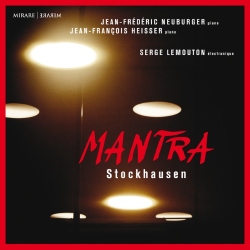
Mantra
Released Album
Recent Album

Featured Album
Works Info
Composer:Karlheinz StockhausenGenre:KeyboardStyle:Electro-Acoustic MusicCompose Date:1970Average_duration:67:31Karlheinz Stockhausen's "Mantra" is a composition for two pianos and electronics, composed between 1970 and 1971. It premiered on March 17, 1972, in Hamburg, Germany, with the composer and pianist Christoph Caskel performing. The piece is divided into 13 movements, each with its own unique character and musical material. The title "Mantra" refers to a repeated phrase or sound that is used as a meditative tool in Hindu and Buddhist traditions. In this piece, Stockhausen uses a 13-note "mantra" that is repeated throughout the work, serving as a unifying element. The pianos are tuned a quarter-tone apart, creating a unique harmonic language that is further expanded upon through the use of electronic manipulation. The first movement begins with a simple statement of the mantra, which is then gradually transformed and developed throughout the piece. The second movement features a more complex rhythmic structure, with the pianos playing in different time signatures. The third movement introduces electronic processing, with the pianos being fed through a ring modulator to create a metallic, bell-like sound. The fourth movement is a slow, meditative section that features the pianos playing in unison. The fifth movement is a lively, dance-like section that features syncopated rhythms and playful melodies. The sixth movement is a more introspective section, with the pianos playing soft, delicate phrases. The seventh movement features a driving, rhythmic ostinato that builds in intensity. The eighth movement is a more abstract section, with the pianos playing clusters of notes and exploring different timbres. The ninth movement is a return to the meditative mood of the fourth movement, with the pianos playing in unison once again. The tenth movement features a complex, polyrhythmic texture, with the pianos playing in different time signatures and tempos. The eleventh movement is a more atmospheric section, with the pianos playing soft, sustained chords. The twelfth movement is a return to the driving, rhythmic energy of the seventh movement. The final movement is a culmination of the previous movements, with the pianos and electronics coming together in a grand, climactic finale. The piece ends with a final statement of the mantra, bringing the work full circle. Overall, "Mantra" is a complex and challenging work that showcases Stockhausen's innovative approach to composition and his interest in exploring new sonic possibilities. The use of electronic processing and the unique tuning of the pianos create a rich, otherworldly sound that is both mesmerizing and unsettling. The piece requires a high level of technical skill and precision from the performers, making it a tour de force of contemporary piano music.More....
Works Music
Released Music

Featured Music