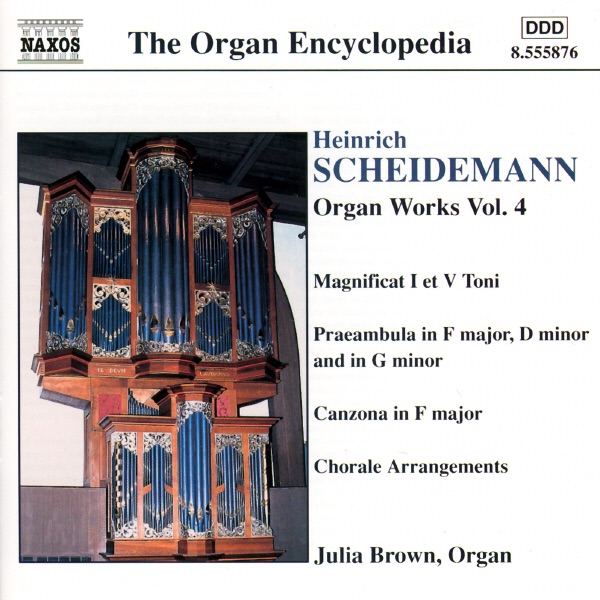
Heinrich Scheidemann
Praembulum for organ in F major
Released Album
Recent Album
Works Info
Composer:Heinrich ScheidemannGenre:KeyboardStyle:KeyboardAverage_duration:2:07Heinrich Scheidemann was a German composer and organist who lived from 1595 to 1663. He was a prominent figure in the North German organ school, which was a group of composers and performers who were active in the 17th century. Scheidemann's Praembulum for organ in F major is one of his most famous works, and it is a great example of his style and technique. The Praembulum for organ in F major was composed in the early 17th century, although the exact date is not known. It was likely written for use in church services, as Scheidemann was the organist at the St. Catherine's Church in Hamburg. The piece is in four movements, and each movement has its own unique characteristics. The first movement is marked "Praeambulum," which means prelude. It is a lively and energetic piece that showcases Scheidemann's skill as an organist. The movement is in F major and is written in a free form, which means that there is no set structure or pattern. This allows Scheidemann to explore different harmonies and textures, and he uses this freedom to create a piece that is both exciting and expressive. The second movement is marked "Fuga," which means fugue. This movement is more structured than the first, as it follows the traditional fugue form. A fugue is a type of composition in which a theme is introduced and then repeated and developed throughout the piece. Scheidemann's fugue is in F major and is written for four voices. The theme is introduced in the first voice and is then repeated and developed in the other voices. The movement is a great example of Scheidemann's skill as a contrapuntist, as he weaves the different voices together to create a complex and beautiful piece. The third movement is marked "Ricercar," which means to search out. This movement is similar to the fugue in that it is a structured piece that follows a set form. However, the ricercar is more free than the fugue, as it allows the composer to explore different harmonies and textures. Scheidemann's ricercar is in F major and is written for three voices. The movement is a great example of Scheidemann's skill as a composer, as he uses the different voices to create a piece that is both complex and beautiful. The final movement is marked "Canzona," which means song. This movement is a more relaxed and lyrical piece than the previous movements. It is in F major and is written for four voices. The movement is a great example of Scheidemann's skill as a composer, as he uses the different voices to create a piece that is both beautiful and expressive. Overall, Scheidemann's Praembulum for organ in F major is a great example of his style and technique. The piece is a showcase of his skill as an organist and composer, and it is a great example of the North German organ school. The four movements each have their own unique characteristics, and they come together to create a piece that is both exciting and beautiful.More....