


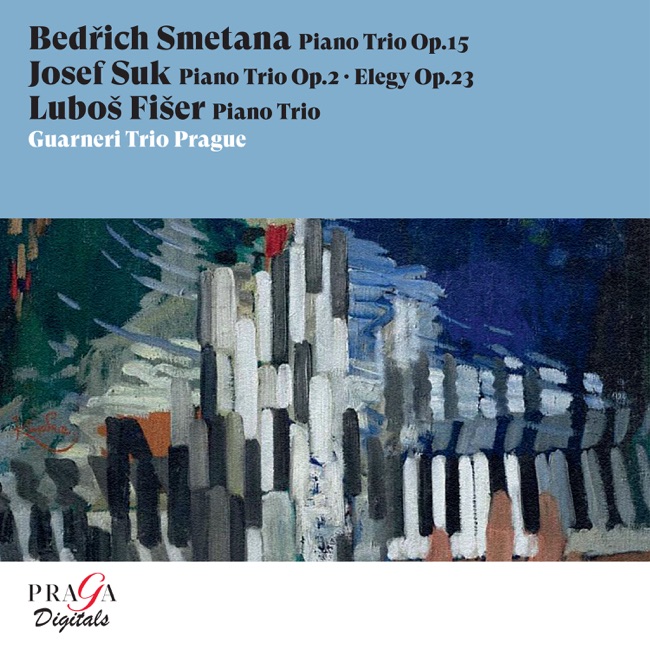
Luboš Fišer
Released Album
Chamber
Keyboard
-
 January 27, 2017
Artist Info
Role:ComposerBirth:1935Death:1999Luboš Fišer was a Czech composer, born on September 30, 1935, in Prague, Czechoslovakia. He was the son of a famous Czech composer, Josef Fišer, who was also a professor at the Prague Conservatory. Luboš Fišer grew up in a musical family and started playing the piano at a young age. He showed a great interest in music and began composing his own pieces when he was only 12 years old. Fišer studied at the Prague Conservatory, where he was taught by some of the most prominent Czech composers of the time, including Emil Hlobil and Jaroslav Řídký. He later continued his studies at the Academy of Performing Arts in Prague, where he studied composition with Pavel Bořkovec and conducting with Václav Neumann. Fišer's early works were influenced by the avant-garde movement, and he was particularly interested in electronic music. In the 1960s, he became a member of the Czechoslovakian Musica Nova group, which was dedicated to promoting contemporary music. Fišer's early works, such as his String Quartet No. 1 and his Sonata for Piano, were experimental and often dissonant. In the 1970s, Fišer's style began to change, and he started to incorporate more traditional elements into his music. He became interested in film music and began composing scores for Czech and international films. His most famous film score is probably the one he composed for the 1971 film Valerie and Her Week of Wonders, which is now considered a cult classic. Fišer's music is characterized by its emotional intensity and its ability to evoke a wide range of moods and feelings. His works often feature complex harmonies and rhythms, and he was known for his use of unconventional instruments and techniques. He was also interested in the relationship between music and other art forms, such as literature and film. Fišer's most famous works include his Symphony No. 2, which was premiered in 1967, and his Requiem, which he composed in 1981. The Requiem is a powerful and emotional work that was inspired by the death of Fišer's father. It features a large orchestra, a choir, and soloists, and it is considered one of the most important works of Czech choral music. Fišer also composed a number of operas, including The Gift of the Magi, which was based on the short story by O. Henry, and The Red Heifer, which was based on a play by Jiří Mucha. His operas are known for their lyrical melodies and their ability to tell complex stories through music. In addition to his work as a composer, Fišer was also a respected conductor and music educator. He served as the conductor of the Prague Symphony Orchestra from 1976 to 1986, and he was a professor of composition at the Academy of Performing Arts in Prague from 1986 until his death in 1999. Fišer's contributions to Czech music were significant, and his works continue to be performed and recorded today. He was a versatile composer who was able to incorporate a wide range of influences into his music, and his legacy continues to inspire new generations of composers and musicians.More....
Recent Artist Music
Copyright Ⓒ 2013 Davinci Finger. All rights reseved
Service Terms & Policy