


Johann Kaspar Kerll
Released Album
Keyboard
-
 March 30, 2023
 -
 October 21, 2022
 -
 January 7, 2022
 -
 October 15, 2021
 -
 June 4, 2021
 -
 April 6, 2018
Chamber
-
 January 5, 2024
 -
 June 4, 2012
 -
 October 30, 2001
 -
Choral
-
 September 30, 2016
 -
 September 30, 2013
 -
 May 31, 2013
 -
 February 24, 2009
 -
 March 22, 2005
 -
 March 28, 2003
Artist Info
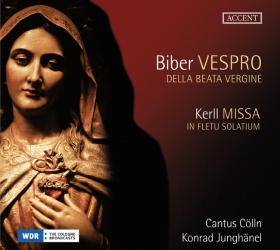
Role:ComposerBirth:April 9, 1627 in Adorf, SaxonyDeath:February 13, 1693 in Munich, GermanyPeriod:BaroqueJohann Kaspar Kerll was a German composer and organist who lived during the Baroque period. He was born on April 9, 1627, in Adorf, a small town in the Vogtland region of Saxony. His father, Caspar Kerll, was a schoolmaster and musician, and it was under his guidance that Johann Kaspar began his musical education. Kerll's early years were spent in Adorf, where he received his first musical training from his father. He showed great promise as a musician from an early age, and by the time he was a teenager, he was already an accomplished organist and composer. In 1643, at the age of 16, he left Adorf to study music in Vienna. In Vienna, Kerll studied with some of the most prominent musicians of the time, including Giovanni Valentini and Johann Jakob Froberger. He quickly established himself as a talented composer and performer, and in 1656, he was appointed court organist to the Holy Roman Emperor Leopold I. Kerll's time at the imperial court was a period of great productivity for him. He composed a large number of works for the court, including operas, cantatas, and instrumental music. His music was highly regarded by his contemporaries, and he was considered one of the leading composers of his time. One of Kerll's most famous works is his Missa in Fletu Solatium, or "Mass for the consolation of the grieving." This work was composed in 1664, in memory of the Emperor's first wife, who had died the previous year. The mass is a deeply emotional and expressive work, and it is considered one of the finest examples of Baroque choral music. Another notable work by Kerll is his Passacaglia in D minor for organ. This piece is a set of variations on a repeating bass line, and it is considered one of the most important works in the organ repertoire. It is a virtuosic piece that showcases the full range of the organ's capabilities, and it has been performed and recorded by many of the world's leading organists. Kerll's music was highly influential in his time, and it had a significant impact on the development of Baroque music. His use of complex harmonies and intricate counterpoint was groundbreaking, and it paved the way for the music of later composers such as Johann Sebastian Bach. Despite his success as a composer and performer, Kerll's personal life was marked by tragedy. He lost his wife and two of his children to the plague, and he himself suffered from poor health in his later years. He died on February 13, 1693, in Munich, where he had been serving as court organist to the Elector of Bavaria. Today, Kerll is remembered as one of the most important composers of the Baroque period. His music continues to be performed and recorded by musicians around the world, and his legacy lives on in the works of later composers who were influenced by his innovative style.More....
Recent Artist Music
1
53
10
Toccata sive ricercata in Cylindrum phonotacticum transferenda (from Kirchner's Musurgia universalis, Rome 1650)
Ricercata in cylindrum phonotacticum transferenda
3:9

Copyright Ⓒ 2013 Davinci Finger. All rights reseved
Service Terms & Policy