


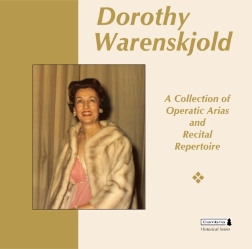
Dorothy Warenskjold
Artist Info
Period:RomanticModernGenre:OperaVocalDorothy Warenskjold was a renowned American soprano who made a significant contribution to the world of classical music. Born on May 3, 1921, in Minneapolis, Minnesota, Warenskjold was the daughter of Norwegian immigrants. Her parents were both musically inclined, and they encouraged their daughter to pursue music from a young age. Warenskjold began her musical training at the age of six, studying piano and voice. She showed exceptional talent and was soon performing in local concerts and recitals. Her parents recognized her potential and decided to send her to the Curtis Institute of Music in Philadelphia, where she studied under the tutelage of the renowned soprano, Elisabeth Schumann. Warenskjold's time at the Curtis Institute was a turning point in her career. She honed her skills and developed a unique style that would set her apart from other sopranos. She made her professional debut in 1943, performing with the Philadelphia Orchestra under the baton of Eugene Ormandy. The performance was a resounding success, and Warenskjold was hailed as a rising star in the classical music world. Over the next few years, Warenskjold continued to perform with some of the most prestigious orchestras in the United States, including the New York Philharmonic, the Boston Symphony Orchestra, and the Chicago Symphony Orchestra. She also made her debut at the Metropolitan Opera in 1948, playing the role of Pamina in Mozart's "The Magic Flute." Warenskjold's performances were characterized by her clear, pure voice and her ability to convey emotion through her singing. She was particularly renowned for her interpretations of Mozart's operas, which she performed with great sensitivity and nuance. Her performances of "The Marriage of Figaro" and "Don Giovanni" were particularly acclaimed. In addition to her operatic performances, Warenskjold was also a sought-after concert singer. She performed in recitals across the United States and Europe, showcasing her versatility and range. She was equally at home singing lieder, art songs, and oratorios, and her performances were always marked by her impeccable technique and musicality. Warenskjold's career was not without its challenges. In the 1950s, she suffered from a vocal cord injury that threatened to end her career. However, she worked tirelessly to rehabilitate her voice, and she eventually made a full recovery. She also faced discrimination as a woman in a male-dominated industry, but she refused to let this hold her back. She continued to perform and to inspire other women to pursue careers in classical music. Throughout her career, Warenskjold received numerous awards and accolades. In 1951, she won the Metropolitan Opera Auditions of the Air, which helped to launch her career. She also won the prestigious Naumburg Award in 1952, which recognized her as one of the most promising young singers of her generation. In 1954, she was awarded the Prix de Rome, which allowed her to study in Italy for a year. Warenskjold retired from performing in the 1970s, but she continued to teach and to mentor young singers. She was a beloved figure in the classical music world, and her legacy continues to inspire generations of musicians. In conclusion, Dorothy Warenskjold was a remarkable soprano who made a significant contribution to the world of classical music. Her clear, pure voice and her ability to convey emotion through her singing set her apart from other sopranos of her generation.More....
Recent Artist Music
2
Carl Rosa
To Be Near Thee
2:54
Copyright Ⓒ 2013 Davinci Finger. All rights reseved
Service Terms & Policy