


Georg Caspar Schürmann
Released Album
Opera
-
 December 30, 2022
 -
 November 19, 2021
 -
 September 14, 2018
 -
 2005
2005
Choral
-
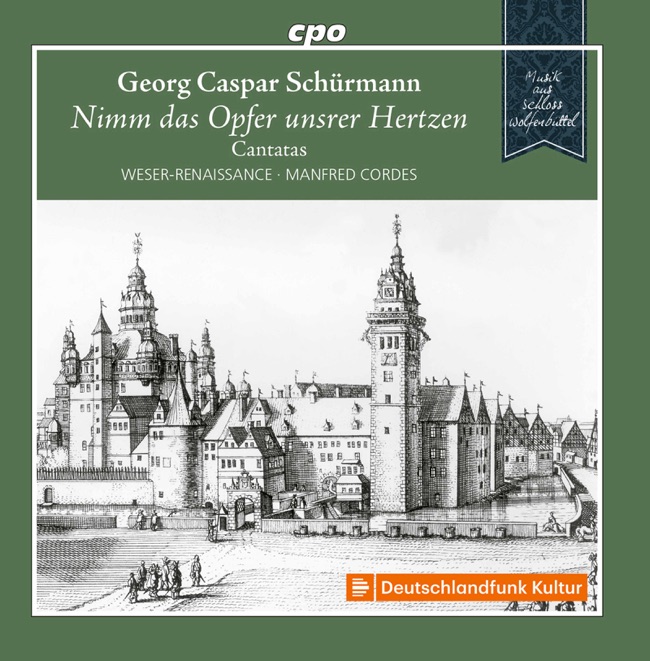 August 13, 2021
Artist Info
Role:ComposerBirth:ca. 1672Death:1751Georg Caspar Schürmann was a German composer and musician who lived during the Baroque period. He was born in 1672 in Rinteln, a small town in Lower Saxony, Germany. Schürmann was the son of a musician and was raised in a musical family. His father, Johann Schürmann, was a court musician and composer, and his mother, Anna Maria, was a singer. Schürmann began his musical education at a young age, studying with his father and other local musicians. He showed great talent and was soon recognized as a prodigy. At the age of 14, he was sent to study with the famous composer Johann Christoph Pez in Hanover. Pez was impressed with Schürmann's abilities and took him on as a student. After several years of study with Pez, Schürmann began to establish himself as a composer and musician. He worked as a court musician in various cities throughout Germany, including Hanover, Wolfenbüttel, and Celle. In 1702, he was appointed Kapellmeister (music director) at the court of the Duke of Brunswick-Lüneburg in Celle, a position he held for the rest of his life. Schürmann's music was highly regarded during his lifetime and he was considered one of the leading composers of his time. He wrote music in a variety of genres, including opera, cantatas, chamber music, and keyboard music. His music was characterized by its elegance, lyricism, and emotional depth. One of Schürmann's most famous works is his opera "Dido and Aeneas," which was first performed in Celle in 1707. The opera is based on the story of Dido, the queen of Carthage, and her doomed love affair with the Trojan hero Aeneas. The opera was a great success and was performed throughout Germany and Austria. Schürmann also wrote a number of cantatas, which were performed in the Lutheran churches of Germany. His cantatas were known for their beautiful melodies and expressive harmonies. One of his most famous cantatas is "Ich bin die Auferstehung und das Leben" (I am the Resurrection and the Life), which was written for the funeral of the Duke of Brunswick-Lüneburg in 1735. In addition to his vocal music, Schürmann also wrote a great deal of instrumental music. He wrote a number of sonatas for various instruments, including the violin, flute, and harpsichord. His sonatas were known for their virtuosity and technical difficulty. Schürmann's music was highly influential and was widely performed during his lifetime. His music was also influential on later composers, including Johann Sebastian Bach, who was a great admirer of Schürmann's music. Bach even transcribed one of Schürmann's sonatas for harpsichord and included it in his own collection of keyboard music. Despite his success as a composer, Schürmann's personal life was marked by tragedy. He was married twice and had several children, but many of them died at a young age. Schürmann himself died in 1751 at the age of 79. Today, Schürmann's music is still performed and admired by musicians and music lovers around the world. His music is known for its beauty, elegance, and emotional depth, and his legacy as a composer and musician continues to inspire new generations of musicians.More....
Recent Artist Music

3
Up! Shout out, sing praises to the king of honor!
Chor. Auf! Jauchzet, lobsinget dem König der Ehren!
2:52
Copyright Ⓒ 2013 Davinci Finger. All rights reseved
Service Terms & Policy