


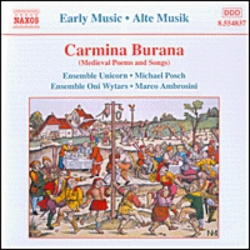
Carmina Burana Anonymous
Released Album
Vocal
-
-
 January 27, 2017
 -
 March 25, 2016
 -
 January 3, 2012
 -
 November 9, 2010
 -
 April 27, 2010
Artist Info
Role:ComposerCountry: ItalyPeriod:MedievalGenre:VocalCarmina Burana is a collection of medieval poems that were discovered in the early 19th century in a Bavarian monastery. The poems were written in Latin, Middle High German, and Old French, and they cover a wide range of topics, including love, drinking, and the fickleness of fortune. The poems were written by various authors, but they were all compiled into a single manuscript, which is now known as the Codex Buranus. The music for Carmina Burana was composed by an anonymous composer in the 13th century. The composer is not known, but it is believed that he was a member of the clergy, as the music is written in a style that was common in the church at the time. The music was written for a group of singers and instrumentalists, and it was intended to be performed in a secular setting, rather than in a church. The music for Carmina Burana was rediscovered in the 20th century by the German composer Carl Orff. Orff was born in Munich in 1895, and he began his musical career as a pianist and composer. He studied at the Munich Academy of Music, and he later became a professor of music at the same institution. Orff was interested in the music of the Middle Ages, and he was particularly drawn to the music of Carmina Burana. He was fascinated by the raw energy and earthy humor of the poems, and he saw in them a reflection of the human condition that was still relevant in the modern world. In 1935, Orff began work on a musical setting of Carmina Burana. He used a selection of the poems from the manuscript, and he set them to music for a large orchestra, chorus, and soloists. The resulting work, which was titled Carmina Burana, premiered in Frankfurt in 1937, and it was an immediate success. Carmina Burana is now one of the most popular works in the classical repertoire. It is known for its driving rhythms, lush harmonies, and powerful choral writing. The work is divided into three sections, each of which explores a different aspect of the human experience. The first section, titled "Springtime," celebrates the joys of youth and the pleasures of the natural world. The music is bright and energetic, and it features a number of lively dance rhythms. The second section, titled "In the Tavern," explores the darker side of human nature. The music is more somber and introspective, and it features a number of solo vocal passages that express the pain and suffering of the human condition. The final section, titled "The Court of Love," celebrates the power of love and the beauty of the human spirit. The music is grand and majestic, and it features a number of soaring choral passages that express the triumph of the human spirit over adversity. Carmina Burana has been performed countless times since its premiere in 1937. It has been recorded by numerous orchestras and conductors, and it has been featured in a number of films and television shows. The work has become a cultural touchstone, and it continues to inspire audiences around the world with its timeless message of hope and resilience.More....
Recent Artist Music
2
2:44
4
4:34
Copyright Ⓒ 2013 Davinci Finger. All rights reseved
Service Terms & Policy