


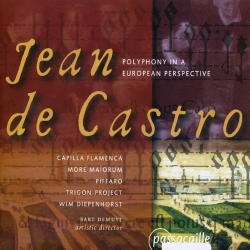
Jean de Castro
Released Album
Vocal
-
 September 9, 2022
 -
 October 8, 2009
 -
 June 21, 2005
 -
 August 29, 2000
Artist Info
Role:ComposerBirth:ca. 1540Death:ca. 1600Period:RenaissanceGenre:ChoralVocalJean de Castro was a prominent composer of the Renaissance period, born in Flanders in the early 16th century. Not much is known about his early life, but it is believed that he received his musical education in the Low Countries, where he was exposed to the rich musical traditions of the region. Castro's musical career began in earnest when he was appointed as a singer at the court of the Archduke Charles of Austria in Brussels. It was here that he began to develop his skills as a composer, writing music for the court and for the various religious institutions in the city. One of the highlights of Castro's early career was his appointment as the maestro di cappella at the Cathedral of St. Rombouts in Mechelen, a position he held from 1563 until his death in 1575. During his time at the cathedral, Castro composed a number of works for the choir, including masses, motets, and hymns. Castro's music was highly regarded during his lifetime, and he was known for his skillful use of counterpoint and his ability to create complex and intricate musical textures. His music was also notable for its emotional depth and expressive power, which was particularly evident in his settings of sacred texts. One of Castro's most famous works is his Missa super 'Il est bel et bon', a mass based on a popular French chanson. The mass is notable for its lively and playful character, which is a departure from the more serious and solemn character of many other Renaissance masses. Another notable work by Castro is his setting of the Lamentations of Jeremiah, which is considered to be one of the finest examples of Renaissance polyphony. The work is characterized by its rich harmonies and intricate counterpoint, which create a sense of profound sadness and mourning. Castro's music was also influenced by the emerging Baroque style, which was beginning to take hold in Europe during his lifetime. This can be seen in his use of chromaticism and his experimentation with new harmonic and melodic structures. Despite his many accomplishments, Castro's music fell out of favor in the centuries following his death, and it was not until the 20th century that his music began to be rediscovered and appreciated by modern audiences. Today, his music is recognized as some of the finest examples of Renaissance polyphony, and his contributions to the development of Western classical music are widely acknowledged. In conclusion, Jean de Castro was a highly skilled and influential composer of the Renaissance period, whose music continues to be celebrated and admired by musicians and music lovers around the world. His contributions to the development of Western classical music are significant, and his legacy continues to inspire and influence composers to this day.More....
Recent Artist Music

Copyright Ⓒ 2013 Davinci Finger. All rights reseved
Service Terms & Policy