


Théodore Gouvy
Released Album
Chamber
-
 April 18, 2014
 -
 May 28, 2013
 -
 February 18, 2013
 -
 April 14, 2009
 -
 January 20, 2006
 -

Symphony
-
-
 January 30, 2012
 -
 January 26, 2010
 -
 May 26, 2009
Keyboard
-
 December 1, 2014
 -
 November 11, 2014
 -
 January 11, 2013
Vocal
-
 September 9, 2014
 -
 September 16, 2000
 -
 October 1, 1999
Artist Info
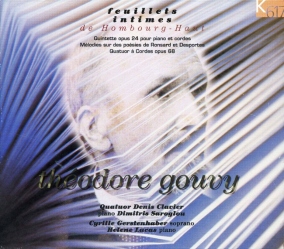
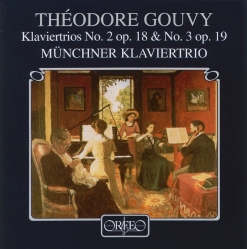
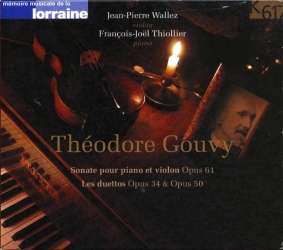
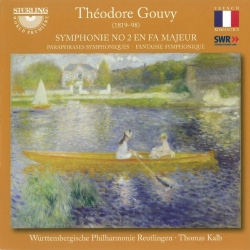
Role:ComposerCountry: FranceBirth:July 3, 1819 in Goffontaine, Saarbrücken, GermanyDeath:April 21, 1898 in Leipzig, GermanyPeriod:RomanticGenre:ChamberKeyboardVocalThéodore Gouvy was a French composer of the Romantic era, born on July 3, 1819, in Goffontaine, a small village in the Lorraine region of France. He was the son of a wealthy industrialist and landowner, and his family was well-connected in the local community. Gouvy showed an early interest in music, and his parents encouraged his musical education. He began studying piano and composition at a young age, and by the time he was a teenager, he was already composing his own works. Gouvy's musical education continued at the Paris Conservatory, where he studied composition with Fromental Halévy and piano with Pierre Zimmermann. He was a diligent student and quickly gained a reputation as a talented composer. In 1843, he won the prestigious Prix de Rome, which allowed him to study in Italy for several years. During his time in Italy, Gouvy was exposed to the works of the great Italian composers, including Rossini, Verdi, and Donizetti. He also became interested in the music of the German Romantics, particularly Schumann and Mendelssohn. Upon his return to France, Gouvy settled in Paris and began to establish himself as a composer. He quickly gained a reputation as a skilled composer of chamber music, and his works were performed by some of the leading musicians of the day. In 1855, he was appointed professor of composition at the Paris Conservatory, a position he held for several years. Gouvy's music is characterized by its lyricism, elegance, and refined craftsmanship. He was a master of counterpoint and harmony, and his works are notable for their sophisticated use of chromaticism and modulation. His music is often compared to that of Schumann and Mendelssohn, but it also shows the influence of French composers such as Fauré and Debussy. One of Gouvy's most famous works is his Symphony No. 2 in F major, Op. 12. This work, composed in 1861, is a masterpiece of the Romantic symphonic tradition. It is notable for its rich orchestration, soaring melodies, and dramatic contrasts. The symphony was well-received by audiences and critics alike, and it helped to establish Gouvy as one of the leading composers of his time. Gouvy was also a prolific composer of chamber music. His String Quartet No. 4 in D minor, Op. 67, is a particularly fine example of his chamber music writing. This work, composed in 1887, is notable for its intricate counterpoint, expressive melodies, and rich harmonies. It is considered one of the finest string quartets of the late Romantic era. In addition to his instrumental works, Gouvy also composed a number of vocal works, including operas, cantatas, and choral works. His opera, Le Cid, was premiered in 1873 and was well-received by audiences and critics. The opera is notable for its dramatic intensity, lyrical melodies, and sophisticated orchestration. Despite his success as a composer, Gouvy's music fell out of favor in the years following his death in 1898. This was due in part to the rise of French impressionism, which favored a more atmospheric and evocative style of music. However, in recent years, there has been a renewed interest in Gouvy's music, and his works are once again being performed and recorded. Théodore Gouvy was a gifted composer whose music deserves to be better known. His works are notable for their elegance, refinement, and sophisticated craftsmanship. He was a master of counterpoint and harmony, and his music is a testament to the enduring power of the Romantic tradition.More....
Recent Artist Music

2
7:50








Copyright Ⓒ 2013 Davinci Finger. All rights reseved
Service Terms & Policy