


Ernest Bristow Farrar
Released Album
Vocal
-
 November 11, 2014
 -
 April 3, 2006
 -
 September 9, 1997
Orchestral
-
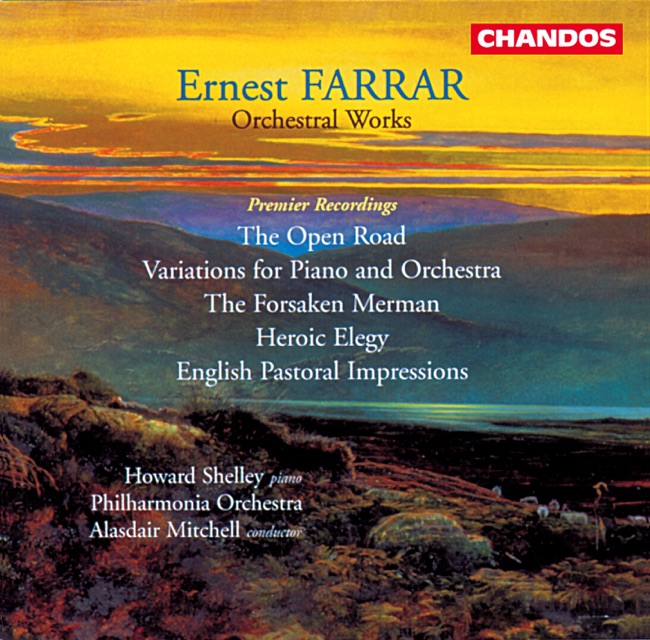 December, 1997
Artist Info
Role:ComposerBirth:July 7, 1885Death:September 18, 1918Period:ModernGenre:OrchestralVocalErnest Bristow Farrar was a British composer and musician who lived from 1885 to 1918. He was born in Lewisham, London, to a family of musicians. His father, George Farrar, was a music teacher and organist, and his mother, Mary Bristow, was a singer. Ernest showed an early talent for music and began studying the piano and violin at a young age. Farrar attended the Royal College of Music in London, where he studied composition with Charles Villiers Stanford and piano with Tobias Matthay. He was a gifted student and won several prizes for his compositions, including the prestigious Mendelssohn Scholarship in 1908. This scholarship allowed him to travel to Germany and study with Max Bruch in Berlin. Farrar's early compositions were influenced by the Romantic style of composers such as Bruch and Brahms. He wrote several works for orchestra, including a symphony and a tone poem, as well as chamber music and songs. His music was well-received by critics and audiences, and he was considered a rising star in the British music scene. In 1914, Farrar enlisted in the British Army at the outbreak of World War I. He served as a lieutenant in the Grenadier Guards and was sent to the Western Front in France. Despite the dangers of war, Farrar continued to compose music in his spare time. He wrote several pieces for military band, including a march and a suite, as well as a setting of the hymn "Abide with Me" for choir and orchestra. Tragically, Farrar was killed in action on September 18, 1918, at the age of 33. His death was a great loss to the music world, as he was considered one of the most promising young composers of his generation. His music fell into obscurity after his death, but has recently been rediscovered and performed by modern musicians. One of Farrar's most famous works is his tone poem "The Forsaken Merman," which he composed in 1907. The piece is based on a poem by Matthew Arnold and tells the story of a merman who is abandoned by his human wife and left to mourn their lost love. The music is lush and romantic, with sweeping melodies and rich harmonies. It has been compared to the music of Richard Strauss and Gustav Mahler. Another notable work by Farrar is his Symphony in E minor, which he composed in 1911. The symphony is in four movements and showcases Farrar's skill as a composer of orchestral music. The first movement is dark and brooding, while the second is more lyrical and melodic. The third movement is a scherzo, with a lively and playful rhythm, and the final movement is a triumphant finale that brings the symphony to a thrilling conclusion. Farrar's music is characterized by its Romantic style, with lush harmonies, sweeping melodies, and dramatic contrasts of light and dark. He was influenced by the music of his time, including the works of Brahms, Bruch, and Wagner, but also had a unique voice of his own. His music is often compared to that of his contemporaries, such as Vaughan Williams and Holst, but is less well-known today. Despite his short life and career, Ernest Bristow Farrar left a lasting legacy in the world of classical music. His music is a testament to his talent and his passion for the art form, and continues to inspire and move audiences today.More....
Recent Artist Music
1
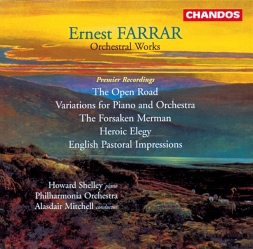
Variations (6), Op. 25
Allegro Moderato- Variation 1: Allegro/ Variation II: Allegretto/ Variation III: Andante/ Variation
11:32
Copyright Ⓒ 2013 Davinci Finger. All rights reseved
Service Terms & Policy