


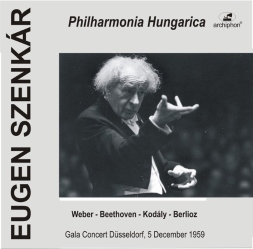
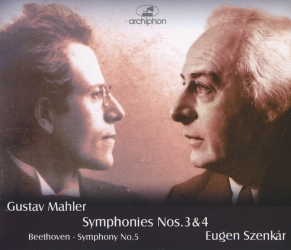
Eugen Szenkar
Released Album
Opera
-
 January 15, 2021
 -
 December 28, 2004
Artist Info
Role:ConductorGenre:OperaEugen Szenkar was a Hungarian-born conductor and pianist who made significant contributions to the world of classical music. He was born on August 22, 1891, in Budapest, Hungary, and showed an early interest in music. His father was a violinist, and his mother was a pianist, which likely influenced his musical upbringing. Szenkar began his formal music education at the Franz Liszt Academy of Music in Budapest, where he studied piano with István Thomán and composition with Zoltán Kodály. He later continued his studies in Vienna with the renowned pianist and composer Ferruccio Busoni. In 1914, Szenkar made his debut as a pianist in Budapest, performing Beethoven's Piano Concerto No. 4. He quickly gained a reputation as a talented pianist and began performing throughout Europe. However, his true passion was conducting, and he soon shifted his focus to this area of music. Szenkar's conducting career began in 1920 when he was appointed as the conductor of the Budapest Opera. He quickly gained a reputation as a skilled conductor and was soon invited to conduct orchestras throughout Europe. In 1924, he made his debut with the Berlin Philharmonic, which was a significant milestone in his career. Over the next few years, Szenkar continued to conduct orchestras throughout Europe, including the Vienna Philharmonic, the London Symphony Orchestra, and the Paris Opera. He also made several recordings during this time, including a recording of Beethoven's Piano Concerto No. 5 with the London Symphony Orchestra. In 1933, Szenkar was appointed as the conductor of the New York Philharmonic, which was one of the most prestigious orchestras in the world at the time. He held this position for two years and made several notable recordings with the orchestra, including a recording of Brahms' Symphony No. 1. After leaving the New York Philharmonic, Szenkar continued to conduct orchestras throughout Europe and the United States. He also began teaching at the Juilliard School in New York City, where he remained until his retirement in 1961. Throughout his career, Szenkar received numerous awards and honors for his contributions to classical music. In 1956, he was awarded the Kossuth Prize, which was the highest honor that could be bestowed upon a Hungarian artist at the time. He was also awarded the Order of Merit of the Republic of Hungary in 1961. Szenkar's legacy in the world of classical music is significant. He was known for his precise and expressive conducting style, which brought out the best in the orchestras he worked with. He was also a talented pianist and composer, although his conducting career overshadowed these other talents. Eugen Szenkar passed away on December 28, 1977, in New York City. He left behind a legacy of excellence in the world of classical music, and his contributions to the art form will be remembered for generations to come.More....
Recent Artist Music
Copyright Ⓒ 2013 Davinci Finger. All rights reseved
Service Terms & Policy