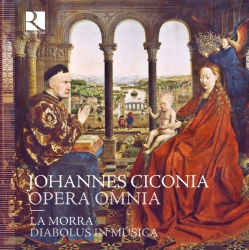
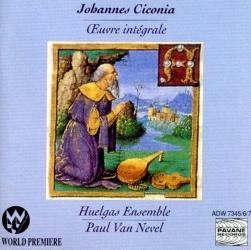
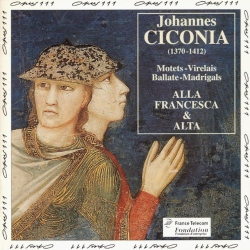
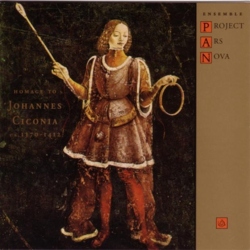
Johannes Ciconia
Caçando un giorno
Released Album
Recent Album
Works Info
Composer:Johannes CiconiaGenre:ChoralStyle:MadrigalCompose Date:ca. 1400Average_duration:3:05Johannes Ciconia was a prominent composer of the late medieval period, known for his innovative and expressive compositions. One of his most famous works is "Caçando un giorno," a secular song that showcases his skill in creating complex and intricate polyphonic textures. "Caçando un giorno" was composed in the early 15th century, likely around 1410-1415. It is believed to have been written for a noble patron, possibly in Italy or France. The song is written in the Italian language, which was a common choice for secular music at the time. The piece is structured as a ballata, a popular form of secular song in the 14th and 15th centuries. It consists of three stanzas, each followed by a refrain. The refrain, "Caçando un giorno per una foresta," is repeated after each stanza, creating a sense of unity and coherence throughout the piece. The music of "Caçando un giorno" is characterized by its intricate polyphony and rhythmic complexity. The vocal lines weave in and out of each other, creating a rich tapestry of sound. The melody is often ornamented with trills, turns, and other embellishments, adding to the song's expressive quality. The text of "Caçando un giorno" tells the story of a hunter who is wandering through a forest in search of game. Along the way, he encounters a beautiful maiden who captures his heart. The refrain, which translates to "Hunting one day in a forest," serves as a reminder of the hunter's original purpose, but also suggests that he has been distracted by the maiden's beauty. Overall, "Caçando un giorno" is a masterful example of late medieval polyphony. Its intricate textures and expressive melodies showcase Ciconia's skill as a composer, and its timeless theme of love and desire continues to resonate with audiences today.More....
Works Music