


Luigi Nono
Variazoni canoniche sulla serie dell' Op. 41
Released Album
Recent Album

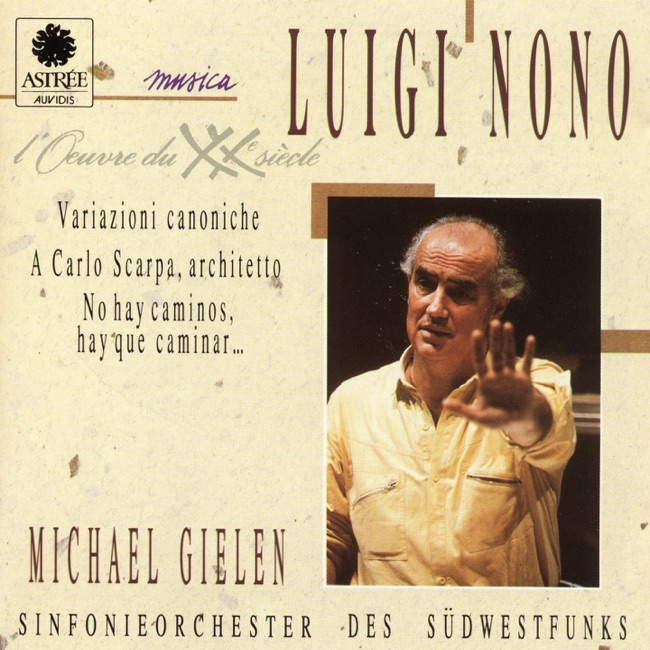
Works Info
Composer:Luigi NonoGenre:OrchestralStyle:CanonCompose Date:1949Average_duration:22:11Movement_count:4Movement ...."Variazioni canoniche sulla serie dell' Op. 41" is a composition by Italian composer Luigi Nono. It was composed in 1950 and premiered in Venice in the same year. The piece consists of six movements, each of which is a variation on a twelve-tone row derived from Arnold Schoenberg's Op. 41. The first movement is a canon in which the row is presented in its original form. The second movement is a canon in inversion, in which the row is played backwards. The third movement is a canon in retrograde, in which the row is played backwards and in reverse order. The fourth movement is a canon in retrograde inversion, in which the row is played backwards and in reverse order, and then inverted. The fifth movement is a canon in which the row is presented in a fragmented form. The final movement is a canon in which the row is presented in a condensed form. The piece is characterized by its use of serialism, a compositional technique in which a series of pitches is used to create a musical work. Nono's use of serialism in "Variazioni canoniche sulla serie dell' Op. 41" is notable for its exploration of the possibilities of the twelve-tone row. Each movement of the piece presents a different variation on the row, demonstrating the range of musical possibilities that can be derived from a single series of pitches. Nono's use of canons in the piece also contributes to its unique character. Canons are a type of musical composition in which a melody is imitated by one or more voices at a fixed interval. In "Variazioni canoniche sulla serie dell' Op. 41," Nono uses canons to create a sense of unity and coherence throughout the piece, while also exploring the possibilities of the twelve-tone row. Overall, "Variazioni canoniche sulla serie dell' Op. 41" is a complex and innovative work that demonstrates Nono's mastery of serialism and his ability to create a cohesive musical work from a single series of pitches. Its use of canons and variations on the twelve-tone row make it a unique and compelling piece of music.More....
Works Music
Released Music
1

Canonical variations on the Op. 41 series
Variazioni canoniche über die Reihe des Op. 41 von Arnold Schönberg für Kammerorchester
20:17
2
20:22
3
20:22