Johann Mattheson
Suite for harpsichord No. 1 in D minor
Released Album
Recent Album
Works Info
Composer:Johann MatthesonGenre:KeyboardStyle:KeyboardAverage_duration:16:43Movement_count:7Movement ....Johann Mattheson's 'Suite for harpsichord No. 1 in D minor' is a baroque keyboard work that was composed in the early 18th century. The exact date of composition is unknown, but it is believed to have been written around 1714-1715. The suite consists of seven movements, each with its own unique character and style. The suite opens with a Prelude, a free-form piece that sets the mood for the rest of the work. It is followed by an Allemande, a stately dance in duple meter that was popular in the baroque era. The third movement is a Courante, a lively dance in triple meter that originated in France. The fourth movement is a Sarabande, a slow and solemn dance that was often used as a contrast to the faster movements in a suite. The fifth movement is a Gigue, a lively dance in compound meter that was popular in England and France. The sixth movement is a Menuet, a graceful dance in triple meter that was often used as a courtly dance. The final movement is a Gavotte, a lively dance in duple meter that originated in France. Mattheson's 'Suite for harpsichord No. 1 in D minor' is characterized by its use of counterpoint, ornamentation, and harmonic complexity. The suite is written in the typical baroque style, with each movement featuring a clear structure and a distinct mood. The use of ornamentation, such as trills and mordents, adds to the richness and complexity of the music. The suite was premiered in Hamburg, Germany, where Mattheson was a prominent musician and composer. It was likely performed on a harpsichord, which was the most popular keyboard instrument of the time. The suite was well-received by audiences and helped establish Mattheson as a leading composer of his time. Overall, Mattheson's 'Suite for harpsichord No. 1 in D minor' is a fine example of baroque keyboard music. Its intricate counterpoint, rich harmonies, and varied moods make it a rewarding work for both performers and listeners.More....
Works Music
Released Music
1
1:12
2
1:16
3
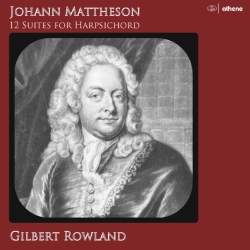
1:6
4
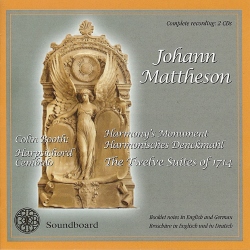
1: