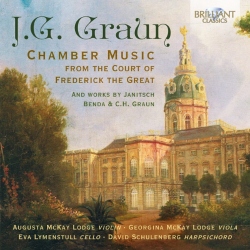
Franz Benda
Sonata for violin (or viola) & continuo in B flat minor, L. III-137
Released Album
Recent Album

Works Info
Composer:Franz BendaGenre:ChamberCompose Date:before 1762Average_duration:10:07Movement_count:3Movement ....The Sonata for violin (or viola) & continuo in B flat minor, L. III-137, was composed by Franz Benda, a German violinist and composer of the Baroque era. The exact date of composition is unknown, but it is believed to have been written in the mid-18th century. The piece consists of three movements: Adagio, Allegro, and Presto. The Adagio movement begins with a slow and mournful melody played by the solo instrument, accompanied by the continuo. The melody is then repeated with variations, showcasing the soloist's virtuosity and expressiveness. The movement ends with a brief coda, bringing the piece to a gentle close. The Allegro movement is a lively and energetic dance, featuring a fast-paced melody played by the solo instrument. The continuo provides a steady rhythm and harmonic support, while the soloist performs intricate runs and trills. The movement is characterized by its playful and joyful nature, with occasional moments of tension and drama. The Presto movement is a fast and furious finale, showcasing the soloist's technical prowess and agility. The movement is marked by its rapid-fire runs and arpeggios, as well as its sudden shifts in dynamics and tempo. The continuo provides a driving rhythm, propelling the soloist forward to the thrilling conclusion. Overall, the Sonata for violin (or viola) & continuo in B flat minor, L. III-137, is a masterful example of Baroque chamber music. It showcases the soloist's virtuosity and expressiveness, while also highlighting the interplay between the solo instrument and the continuo. The piece is characterized by its emotional depth, technical complexity, and playful spirit, making it a beloved work in the Baroque repertoire.More....
Works Music