


Robert Radecke
Released Album
Vocal
-
 July 22, 2011
Symphony
-
 April 29, 2016
Chamber
-
 January 20, 2017
Artist Info
Role:ComposerBirth:1830Death:1911Robert Radecke was a German composer and conductor who lived from 1830 to 1911. He was born in Berlin, Germany, on February 10, 1830, into a family of musicians. His father, Carl Radecke, was a well-known composer and conductor, and his mother, Henriette, was a singer. Robert Radecke showed an early interest in music and began studying piano and composition at a young age. Radecke's musical education began at the Berlin Conservatory, where he studied piano with Siegfried Dehn and composition with Carl Friedrich Rungenhagen. He also studied with the famous composer Felix Mendelssohn, who was the director of the conservatory at the time. Radecke's talent as a composer was recognized early on, and he won several awards for his compositions while still a student. After completing his studies at the conservatory, Radecke began his career as a conductor. He worked as a conductor in several German cities, including Leipzig, Dresden, and Berlin. He also worked as a music teacher, teaching piano and composition at the Berlin Conservatory. Radecke's compositions were influenced by the Romantic era of music, and he was known for his use of rich harmonies and expressive melodies. He composed in a variety of genres, including symphonies, chamber music, and opera. Some of his most famous works include his Symphony No. 1 in C minor, his Piano Concerto in E-flat major, and his opera, Der König der Narren (The King of Fools). Radecke's Symphony No. 1 in C minor was composed in 1857 and premiered in Leipzig the following year. The symphony is in four movements and is notable for its use of dramatic contrasts and rich harmonies. The first movement is dark and brooding, while the second movement is more lyrical and expressive. The third movement is a lively scherzo, and the final movement is a triumphant finale. Radecke's Piano Concerto in E-flat major was composed in 1861 and premiered in Berlin the following year. The concerto is in three movements and is notable for its virtuosic piano writing and expressive melodies. The first movement is a lively allegro, the second movement is a lyrical adagio, and the final movement is a lively rondo. Radecke's opera, Der König der Narren, was composed in 1871 and premiered in Berlin the following year. The opera is a romantic comedy set in medieval times and is notable for its lively and expressive music. The opera was well-received at its premiere and was performed frequently in Germany during Radecke's lifetime. In addition to his compositions, Radecke was also known for his work as a conductor. He was the conductor of the Berlin Philharmonic Orchestra from 1877 to 1880 and was also the conductor of the Royal Opera in Berlin. He was known for his precise and expressive conducting style and was highly respected by his colleagues and audiences alike. Radecke continued to compose and conduct throughout his life, and he remained active in the German music scene until his death in Berlin on May 5, 1911. His contributions to the world of classical music are significant, and his works continue to be performed and enjoyed by audiences around the world.More....
Recent Artist Music
4
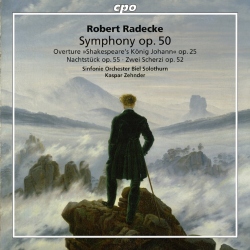
Overture to Shakespeare's King John, Op. 25
Ouvertüre zu Shakespeare's König Johann für großes Orchester Op. 25
10:32
Copyright Ⓒ 2013 Davinci Finger. All rights reseved
Service Terms & Policy