


John Melby
Artist Info
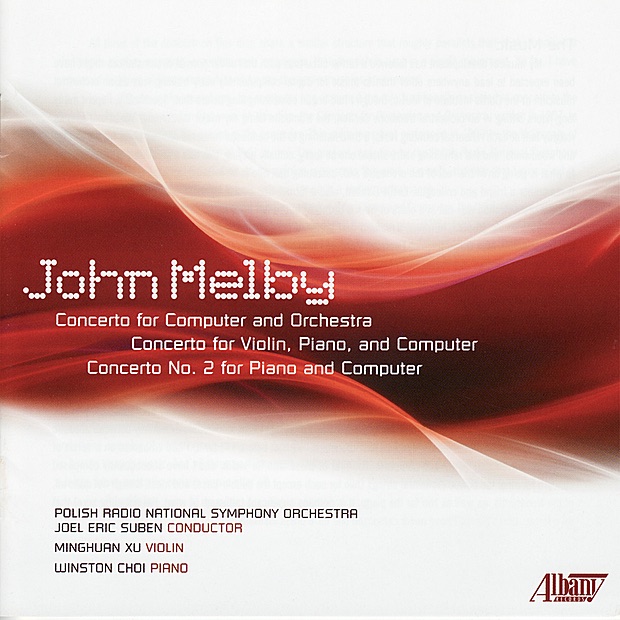
Role:Composer PerformerBirth:1941 in Whitehall, WIGenre:Avant-GardeConcertoJohn Melby was an American composer and music educator who was born on August 7, 1932, in New York City. He grew up in a musical family, with his father being a professional violinist and his mother a pianist. Melby began playing the piano at a young age and showed a natural talent for music. He attended the High School of Music and Art in New York City, where he studied composition with Vittorio Giannini. After graduating from high school, Melby attended the Eastman School of Music in Rochester, New York, where he earned a Bachelor of Music degree in composition. He then went on to study at the University of Illinois at Urbana-Champaign, where he earned a Master of Music degree in composition and a Doctor of Musical Arts degree in composition and theory. Melby's early compositions were influenced by the serialism and atonality of the mid-20th century avant-garde. However, he later developed a more personal style that incorporated elements of jazz, rock, and electronic music. He was particularly interested in the use of technology in music, and he became an early adopter of computer music in the 1960s. Melby's most famous work is probably his electronic composition "Plexure," which was commissioned by the Columbia-Princeton Electronic Music Center in 1969. The piece is a collage of electronic sounds and manipulated recordings of human voices, and it was one of the first works of computer music to gain widespread recognition. "Plexure" was performed at the New York Philharmonic's Horizons '70 festival and was later released on an album by Nonesuch Records. In addition to his electronic music, Melby also composed works for traditional instruments and ensembles. His compositions for orchestra include "Concerto for Orchestra" (1962), "Symphony No. 1" (1964), and "Symphony No. 2" (1970). He also wrote chamber music, including "String Quartet No. 1" (1960) and "Sonata for Violin and Piano" (1961). Melby was a prolific composer throughout his career, and he continued to write music until his death in 2009. He was also a respected music educator, and he taught at the University of Illinois at Urbana-Champaign, the University of California, San Diego, and the University of Illinois at Chicago. He was a founding member of the Society for Electro-Acoustic Music in the United States (SEAMUS) and served as its president from 1981 to 1983. Melby's contributions to the field of electronic music were significant, and his work helped to establish computer music as a legitimate form of artistic expression. His compositions were innovative and experimental, and they pushed the boundaries of what was possible with technology and sound. Despite his groundbreaking work in electronic music, Melby remained committed to traditional forms and techniques, and his compositions for orchestra and chamber ensembles are equally impressive. In conclusion, John Melby was a pioneering composer and music educator who made significant contributions to the field of electronic music. His work was innovative and experimental, and it helped to establish computer music as a legitimate form of artistic expression. Despite his groundbreaking work in electronic music, Melby remained committed to traditional forms and techniques, and his compositions for orchestra and chamber ensembles are equally impressive. His legacy continues to inspire and influence composers and musicians around the world.More....
Recent Artist Music
Copyright Ⓒ 2013 Davinci Finger. All rights reseved
Service Terms & Policy