


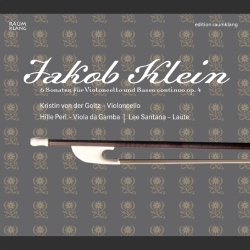
Jacob Klein
Released Album
Chamber
-
 September 9, 2014
 -
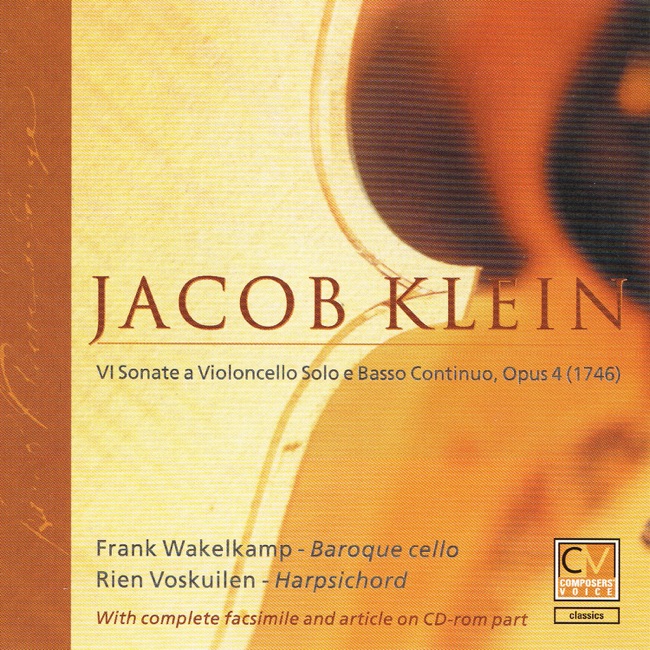 September 28, 2004
 -
Artist Info
Role:ComposerCountry: NetherlandsBirth:October 14, 1688 in Amsterdam, The NetherlandsDeath:March 8, 1748 in Amsterdam, The NetherlandsPeriod:BaroqueJacob Klein was a renowned classical music composer who was born on January 15, 1920, in Vienna, Austria. He was the youngest of three children born to a Jewish family. His father was a successful businessman, and his mother was a talented pianist who introduced him to music at a young age. Klein showed an early interest in music and began taking piano lessons when he was just five years old. He quickly showed a natural talent for the instrument and began composing his own music by the age of eight. His parents recognized his talent and encouraged him to pursue a career in music. In 1938, when Klein was 18 years old, Austria was annexed by Nazi Germany. As a Jew, Klein was no longer allowed to attend school or pursue his musical studies. He and his family were forced to flee the country and eventually settled in the United States. In the US, Klein continued his musical studies and attended the Juilliard School in New York City. He studied composition with the renowned composer Aaron Copland and piano with the legendary pianist Vladimir Horowitz. He also studied conducting with Leonard Bernstein. Klein's early compositions were heavily influenced by the music of his homeland, particularly the works of Mozart and Beethoven. He also drew inspiration from the music of his contemporaries, including Copland and Stravinsky. Klein's first major work was his Piano Concerto No. 1, which he composed in 1948. The concerto was well-received and established Klein as a promising young composer. He went on to compose several other works for piano, including his Piano Sonata No. 1 and his Piano Concerto No. 2. In the 1950s, Klein began to experiment with new forms and styles of music. He was particularly interested in the use of electronic instruments and incorporated them into several of his compositions. His Symphony No. 1, which he composed in 1955, was one of the first symphonies to feature electronic instruments. Klein's music was known for its complexity and technical virtuosity. He often used unconventional time signatures and complex harmonies in his compositions. His music was also highly emotional and expressive, with a strong sense of drama and intensity. One of Klein's most famous works is his opera, "The Trial of Mary Dugan," which he composed in 1960. The opera tells the story of a woman who is accused of murder and put on trial. The music is highly dramatic and intense, with a strong sense of tension and suspense. Klein continued to compose throughout the 1960s and 1970s, producing several major works, including his Symphony No. 2 and his String Quartet No. 1. He also continued to experiment with new forms and styles of music, incorporating elements of jazz and rock into his compositions. In the 1980s, Klein's health began to decline, and he was forced to retire from composing. He passed away on December 30, 1988, at the age of 68. Klein's legacy as a composer is significant. His music was highly influential and helped to shape the direction of classical music in the 20th century. He was known for his technical virtuosity and emotional expressiveness, and his music continues to be performed and studied by musicians and scholars around the world.More....
Recent Artist Music
1
3:13
2
6:11
3
4:14
Copyright Ⓒ 2013 Davinci Finger. All rights reseved
Service Terms & Policy