


Erik Förare
Released Album
Chamber
-
 June 28, 2005
 -
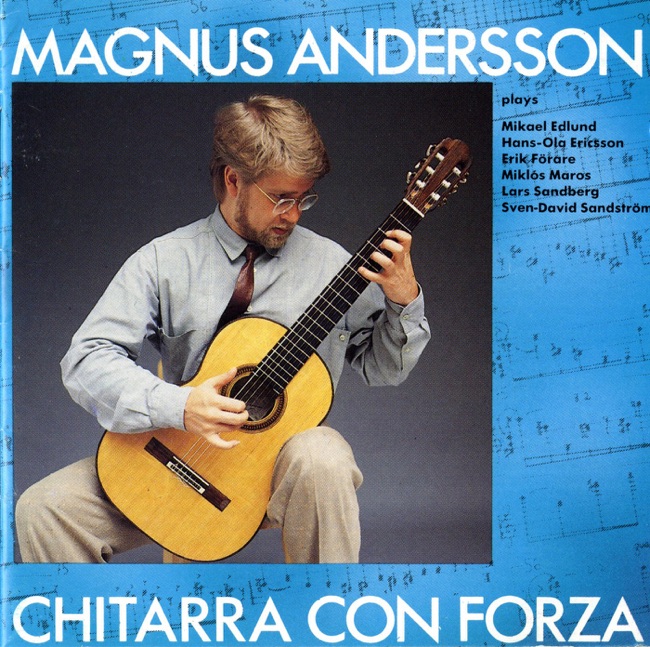 January 1, 1988
Artist Info
Role:ComposerCountry: SwedenBirth:January 25, 1955 in Uppsala, SwedenPeriod:ContemporaryGenre:ChamberErik Förare was a Swedish composer who lived from 1917 to 1997. He was born in the town of Örebro, Sweden, and showed an early interest in music. His parents were both amateur musicians, and they encouraged him to pursue his passion for music. Förare began his formal music education at the age of 10, when he started taking piano lessons. He quickly showed a talent for the instrument, and by the time he was a teenager, he was performing in public concerts. In addition to the piano, he also learned to play the violin and the cello. After completing his secondary education, Förare enrolled in the Royal College of Music in Stockholm. There, he studied composition with the renowned Swedish composer Lars-Erik Larsson. He also studied conducting and music theory. Förare's early compositions were heavily influenced by Larsson's style, which was characterized by a blend of traditional Swedish folk music and classical forms. However, as Förare matured as a composer, he began to develop his own unique voice. One of Förare's early successes was his Piano Concerto, which he composed in 1945. The concerto was premiered by the Swedish Radio Symphony Orchestra, with Förare himself as the soloist. The piece was well-received, and it helped establish Förare as a rising star in the Swedish classical music scene. In the years that followed, Förare continued to compose prolifically. He wrote music for a variety of ensembles, including orchestras, chamber groups, and solo instruments. His music was often characterized by its lyricism and its use of Swedish folk melodies. One of Förare's most famous works is his Symphony No. 2, which he composed in 1953. The symphony is a large-scale work that showcases Förare's skill as an orchestrator. It is notable for its use of Swedish folk melodies, which are woven into the fabric of the music. Another notable work by Förare is his String Quartet No. 1, which he composed in 1957. The quartet is a complex and challenging work that showcases Förare's skill as a composer. It is notable for its use of dissonance and its unconventional harmonic language. In addition to his work as a composer, Förare was also a respected conductor. He served as the conductor of the Gävle Symphony Orchestra from 1956 to 1960, and he also conducted the Swedish Radio Symphony Orchestra on several occasions. Förare's music was well-regarded in Sweden, but he never achieved the same level of international recognition as some of his contemporaries. However, his music has been performed and recorded by a number of Swedish and international ensembles, and it continues to be appreciated by classical music enthusiasts around the world. Förare died in 1997 at the age of 80. He left behind a legacy of music that is characterized by its lyricism, its use of Swedish folk melodies, and its unique harmonic language. His music continues to be performed and recorded, and it remains an important part of the Swedish classical music tradition.More....
Recent Artist Music
Copyright Ⓒ 2013 Davinci Finger. All rights reseved
Service Terms & Policy