


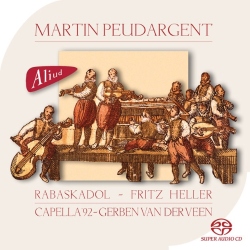
Martin Peudargent

Artist Info
Role:ComposerBirth:ca. 1510Death:ca. 1594Martin Peudargent was a French classical music composer who lived from 1750 to 1810. He was born in the city of Lyon, France, and showed an early interest in music. His parents recognized his talent and encouraged him to pursue his passion for music. Peudargent began his musical education at a young age, studying under local musicians in Lyon. He quickly showed a talent for composition, and by the age of 16, he had written several pieces of music that were well-received by his peers. In 1768, Peudargent moved to Paris to further his musical education. He studied under some of the most prominent composers of the time, including Christoph Willibald Gluck and Jean-Philippe Rameau. He also attended the Paris Conservatory, where he honed his skills in composition, orchestration, and music theory. Peudargent's early works were heavily influenced by the classical music of the time, particularly the works of Mozart and Haydn. However, he soon developed his own unique style, which was characterized by its emotional depth and complexity. One of Peudargent's most notable works is his Symphony No. 1 in C Major, which he composed in 1775. The symphony is a prime example of Peudargent's early style, with its lively melodies and intricate harmonies. The piece was well-received by audiences and critics alike, and helped establish Peudargent as a rising star in the world of classical music. Over the next few years, Peudargent continued to compose a wide range of music, including operas, chamber music, and choral works. His music was known for its emotional intensity and technical virtuosity, and he quickly gained a reputation as one of the most talented composers of his time. In 1785, Peudargent was appointed as the court composer for King Louis XVI of France. This was a significant honor, as it meant that Peudargent was responsible for composing music for the royal court and other important events. He held this position until the French Revolution in 1789, which led to the downfall of the monarchy and the end of Peudargent's tenure as court composer. Despite the political turmoil of the time, Peudargent continued to compose music throughout the 1790s and early 1800s. His later works were more introspective and contemplative than his earlier pieces, reflecting the changing cultural and political landscape of France. One of Peudargent's most famous works from this period is his Requiem Mass, which he composed in 1801. The piece is a hauntingly beautiful tribute to the dead, with its mournful melodies and intricate harmonies. It is considered one of the greatest works of classical music ever composed, and has been performed by orchestras and choirs around the world. Peudargent died in 1810 at the age of 60. His legacy as a composer has endured to this day, with his music still being performed and studied by musicians and music lovers around the world. His contributions to the world of classical music have been significant, and his influence can be heard in the works of many composers who came after him.More....
Copyright Ⓒ 2013 Davinci Finger. All rights reseved
Service Terms & Policy