


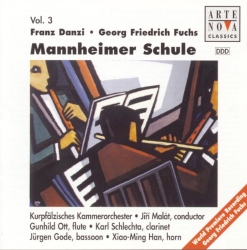
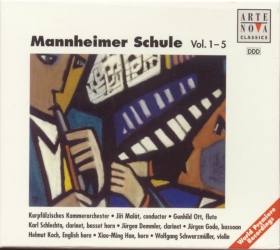
Georg Friedrich Fuchs
Artist Info
Role:ComposerGenre:OrchestralGeorg Friedrich Fuchs was a German composer and conductor who lived from 1752 to 1821. He was born in the town of Hildburghausen, in the state of Thuringia, Germany. Fuchs was the son of a musician, and he began his musical education at a young age. He studied with his father, who was a church organist, and later with Johann Christoph Friedrich Bach, the son of Johann Sebastian Bach. Fuchs showed great talent as a musician from an early age, and he began composing music when he was just a teenager. He wrote his first symphony when he was only 16 years old, and it was performed in his hometown to great acclaim. This early success encouraged Fuchs to pursue a career in music, and he went on to study composition and conducting in Leipzig and Berlin. Fuchs' early works were heavily influenced by the music of Johann Sebastian Bach and his sons, as well as by the classical style of Haydn and Mozart. He wrote a number of symphonies, chamber music pieces, and operas during this time, and his music was well-received by audiences and critics alike. In 1782, Fuchs was appointed as the court conductor in Hildburghausen, where he remained for the rest of his life. He continued to compose music during this time, and his works became more complex and sophisticated. He wrote a number of operas, including "Die Zauberflöte" (The Magic Flute), which was based on a libretto by Emanuel Schikaneder. Fuchs' music was known for its elegance, clarity, and emotional depth. He was a master of orchestration, and his works often featured intricate and colorful instrumentation. His music was also notable for its use of counterpoint and fugue, which he used to great effect in his choral works. One of Fuchs' most famous works is his Requiem in C minor, which he composed in 1800. The piece is a setting of the Catholic Mass for the Dead, and it is known for its dramatic and emotional intensity. The Requiem features a large orchestra, chorus, and soloists, and it is considered to be one of Fuchs' greatest achievements. Fuchs' music was highly regarded during his lifetime, and he was considered to be one of the leading composers of his time. His works were performed throughout Europe, and he was admired by many of his contemporaries, including Beethoven and Schubert. Despite his success as a composer, Fuchs was known for his modesty and humility. He was a deeply religious man, and his faith was reflected in his music. He believed that music was a gift from God, and he saw his role as a composer as a way to glorify God and uplift the souls of his listeners. Fuchs died in 1821, at the age of 69. His legacy as a composer and conductor lives on, and his music continues to be performed and admired by musicians and audiences around the world. His works are known for their beauty, elegance, and emotional depth, and they remain an important part of the classical music canon.More....
Recent Artist Music
Copyright Ⓒ 2013 Davinci Finger. All rights reseved
Service Terms & Policy