


André Souris
Released Album
Chamber
-
 January 29, 2002
 -
 March 1, 1994
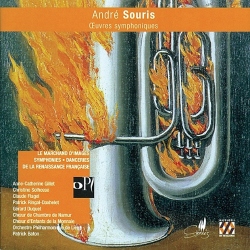
Orchestral
-
 May 15, 2000
Artist Info
Role:ComposerCountry: BelgiumBirth:1899Death:1970Genre:ChamberVocalAndré Souris was a Belgian composer, musicologist, and writer who was born on July 6, 1899, in Ixelles, Belgium. He was the son of a painter and a pianist, and his parents encouraged his interest in music from an early age. Souris began studying music at the Brussels Conservatory when he was just six years old, and he continued his studies there until he was 18. During his time at the conservatory, Souris studied composition with Paul Gilson, a prominent Belgian composer who was known for his work in the Impressionist style. Souris was deeply influenced by Gilson's music, and he would later describe him as his "musical father." In addition to his studies in composition, Souris also studied piano, music theory, and music history. After completing his studies at the conservatory, Souris began working as a music teacher and a music critic. He also began composing his own music, and his early works were heavily influenced by the Impressionist style that he had learned from Gilson. However, as he continued to develop as a composer, Souris began to experiment with new forms and techniques, and his music became increasingly avant-garde. One of Souris's most important works is his opera "Les uns et les autres," which he began composing in 1928. The opera is a complex and highly experimental work that incorporates elements of atonality, serialism, and musique concrète. It tells the story of a group of people who are trapped in a dreamlike world, and it explores themes of identity, memory, and the nature of reality. "Les uns et les autres" was not well-received when it was first performed in 1931, and it was criticized for being too difficult and inaccessible. However, it has since become recognized as a groundbreaking work of 20th-century music, and it has been performed and recorded by many different orchestras and opera companies around the world. In addition to his work as a composer, Souris was also a prolific writer and musicologist. He wrote extensively about music theory, history, and aesthetics, and he was particularly interested in the relationship between music and language. He also wrote several books on the history of music, including a comprehensive history of Western music from ancient Greece to the 20th century. Souris's music and writing were deeply influenced by his political beliefs, and he was an active member of the Belgian Communist Party. He believed that music had the power to inspire social change, and he saw his work as a composer and writer as a way to promote socialist ideals. During World War II, Souris went into hiding to avoid being arrested by the Nazi occupation forces. He continued to compose music and write during this time, and he also worked with the Belgian Resistance to help smuggle Jewish refugees out of the country. After the war, Souris continued to be an active composer and writer, and he remained committed to his socialist ideals. He was a vocal critic of the conservative musical establishment in Belgium, and he worked to promote the work of younger, more experimental composers. Souris died on March 25, 1970, in Brussels, Belgium. He left behind a legacy as one of the most important and influential composers of the 20th century, and his work continues to be studied and performed by musicians and scholars around the world.More....

Copyright Ⓒ 2013 Davinci Finger. All rights reseved
Service Terms & Policy