


Nicolaus a Kempis
Released Album
Chamber
-
 April 17, 2019
 -
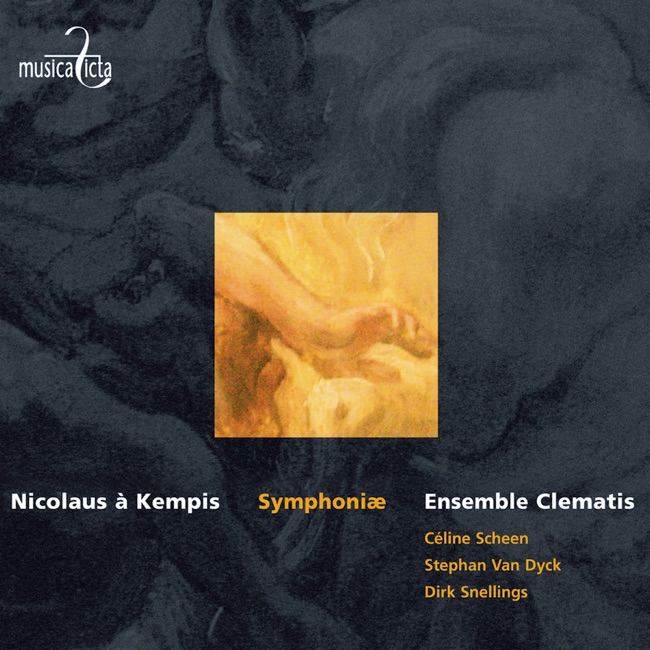 July 27, 2004
 -
 January 1, 1999
 -
 August, 1988
Artist Info
Role:ComposerCountry: BelgiumBirth:1600Death:August, 1676 in Brussels, BelgiumPeriod:BaroqueRomanticContemporaryModernGenre:ChamberKeyboardOperaOrchestralSymphonyNicolaus a Kempis was a German composer and organist who lived during the late Renaissance and early Baroque periods. He was born in 1600 in the city of Nijmegen, which was then part of the Dutch Republic. His father, Johannes a Kempis, was a musician and composer who served as the organist of the St. Stevenskerk in Nijmegen. Nicolaus a Kempis grew up in a musical family and received his early musical education from his father. In 1617, Nicolaus a Kempis moved to Germany to study music at the University of Heidelberg. He studied under the renowned composer and music theorist Johannes Lippius, who was a leading figure in the German musical scene at the time. Under Lippius' guidance, a Kempis developed a deep understanding of music theory and composition, and he began to compose his own works. After completing his studies, a Kempis returned to the Netherlands and began his career as a musician and composer. He served as the organist of the St. Stevenskerk in Nijmegen, the same position his father had held before him. He also worked as a music teacher and composer, and his reputation as a skilled musician and composer began to grow. One of a Kempis' most notable works is his collection of keyboard music, which was published in 1627 under the title "Tabulatura nova." This collection contains a variety of pieces for keyboard instruments, including preludes, fugues, toccatas, and dances. The pieces are written in a variety of styles, ranging from the strict counterpoint of the Renaissance to the more expressive and virtuosic style of the Baroque. Another important work by a Kempis is his collection of sacred vocal music, which was published in 1638 under the title "Cantiones sacrae." This collection contains a number of motets and other sacred works for choir and organ. The pieces are written in a variety of styles, ranging from the simple homophonic style of the early Baroque to the more complex and expressive style of the later Baroque. In addition to his work as a composer, a Kempis was also a skilled organist. He was known for his virtuosic performances and his ability to improvise on the organ. He served as the organist of several churches in the Netherlands, including the St. Stevenskerk in Nijmegen and the Oude Kerk in Amsterdam. Despite his success as a musician and composer, a Kempis' life was not without its challenges. He lived during a time of great political and religious upheaval in Europe, and his homeland of the Netherlands was no exception. The country was divided between Protestant and Catholic factions, and a Kempis' Catholic faith put him at odds with the Protestant authorities who controlled much of the country. In 1648, a Kempis was forced to flee the Netherlands due to his Catholic faith. He moved to Cologne, where he continued to work as a musician and composer. He remained in Cologne for the rest of his life, and he died there in 1676 at the age of 76. Today, Nicolaus a Kempis is remembered as one of the most important composers of the early Baroque period. His works are known for their expressive melodies, complex harmonies, and virtuosic keyboard writing. His influence can be heard in the works of later composers such as Johann Sebastian Bach, who was known to have studied a Kempis' music. In conclusion, Nicolaus a Kempis was a talented musician and composer who made significant contributions to the development of Baroque music.More....
Recent Artist Music
2

2:53



Copyright Ⓒ 2013 Davinci Finger. All rights reseved
Service Terms & Policy