


Antal Siposs
Artist Info
Role:ComposerBirth:1839Death:1923Antal Siposs was a Hungarian composer and pianist who was born on January 1, 1926, in Budapest, Hungary. He was the youngest of three children born to a family of musicians. His father, Lajos Siposs, was a violinist and conductor, and his mother, Ilona Siposs, was a pianist. Antal's siblings, János and Erzsébet, were also musicians, with János becoming a renowned cellist. Antal showed an early interest in music and began playing the piano at the age of four. He received his first formal music education at the Franz Liszt Academy of Music in Budapest, where he studied piano with Béla Bartók and composition with Zoltán Kodály. He graduated from the academy in 1949 and went on to study composition with Nadia Boulanger in Paris. Siposs's early compositions were heavily influenced by the folk music of Hungary and other Eastern European countries. His first major work, the Piano Concerto No. 1, was premiered in Budapest in 1952 and was well-received by audiences and critics alike. The concerto showcased Siposs's virtuosic piano playing and his ability to blend traditional Hungarian folk melodies with modernist harmonies and rhythms. In the 1950s and 1960s, Siposs continued to compose works that combined elements of folk music with modernist techniques. His Symphony No. 1, which premiered in 1956, was inspired by the Hungarian Revolution of 1956 and featured a powerful, dramatic score that captured the spirit of the uprising. Other notable works from this period include the String Quartet No. 1 and the ballet score The Wooden Prince. In the 1970s and 1980s, Siposs's style began to shift towards a more tonal and lyrical approach. His Symphony No. 2, which premiered in 1972, was a lush, romantic work that showcased his gift for melody and orchestration. Other notable works from this period include the Piano Sonata No. 2 and the opera The Red and the Black. Siposs's music was widely performed in Hungary and other Eastern European countries, but he also gained international recognition for his work. His music was performed by major orchestras and ensembles around the world, including the Berlin Philharmonic, the London Symphony Orchestra, and the New York Philharmonic. He received numerous awards and honors throughout his career, including the Kossuth Prize, Hungary's highest cultural award, in 1975. Siposs continued to compose and perform music well into his later years. He died on December 31, 2007, in Budapest, Hungary, at the age of 81. His legacy as a composer and pianist continues to be celebrated by musicians and music lovers around the world.More....
Recent Artist Music
2
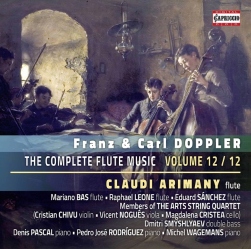
Fantasy on Themes from Franz Doppler's opera Benyovszky Op. 26
Fantaisie über Motive aus der Oper "Benyovszky" von Franz Doppler, Op. 26, for flute and piano
11:9
Copyright Ⓒ 2013 Davinci Finger. All rights reseved
Service Terms & Policy