


Myriam Marbe
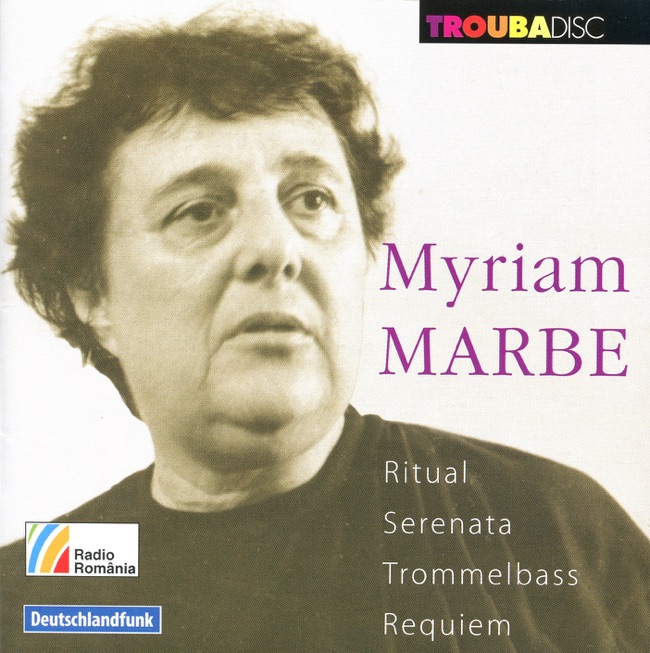
Artist Info
Role:ComposerCountry: RomaniaBirth:April 9, 1931 in Bucharest, RomaniaDeath:1997Period:ContemporaryGenre:Avant-GardeChamberConcertoMyriam Marbe was a Romanian composer and pianist who was born on November 16, 1931, in Piatra Neamț, Romania. She was the daughter of a Jewish family, and her father was a lawyer. Marbe showed an early interest in music and began playing the piano at the age of four. She was a prodigious talent and gave her first public performance at the age of six. Marbe's family moved to Bucharest when she was eight years old, and she continued her musical studies there. She studied piano with Florica Musicescu, who was also the teacher of the famous Romanian pianist Dinu Lipatti. Marbe was a gifted student and won several prizes in national and international piano competitions. In 1949, Marbe began studying composition at the Bucharest Conservatory with Mihail Jora, a prominent Romanian composer. She also studied with other notable Romanian composers, including Paul Constantinescu and Tudor Ciortea. Marbe's early compositions were influenced by the Romanian folk music tradition, and she often incorporated folk melodies and rhythms into her works. Marbe's first major composition was her Piano Concerto No. 1, which she wrote in 1952. The concerto was premiered in Bucharest in 1953, with Marbe as the soloist. The piece was well-received and established Marbe as a promising young composer. In 1955, Marbe won a scholarship to study composition at the Moscow Conservatory with Dmitri Shostakovich, one of the most important composers of the 20th century. Marbe's time in Moscow was a formative experience, and she later described Shostakovich as her "musical father." She also studied with other prominent Soviet composers, including Aram Khachaturian and Nikolai Myaskovsky. Marbe's compositions from this period show the influence of Shostakovich's style, with their use of dissonance and angular melodies. Her Symphony No. 1, which she wrote in 1956, was dedicated to Shostakovich and premiered in Moscow in 1957. The piece was well-received and established Marbe as a major figure in Romanian music. Marbe returned to Romania in 1957 and began teaching composition at the Bucharest Conservatory. She continued to compose prolifically, writing works for orchestra, chamber ensembles, and solo instruments. Her music from this period shows a wide range of influences, including Romanian folk music, Soviet-style modernism, and Western classical music. One of Marbe's most important works from this period is her String Quartet No. 1, which she wrote in 1960. The quartet is a powerful and emotional work that reflects Marbe's personal struggles as a Jewish artist living in Communist Romania. The piece was banned by the Romanian government for its "decadent" style, but it was later performed and recorded by several prominent ensembles. Marbe's music continued to evolve throughout the 1960s and 1970s. She began incorporating more avant-garde techniques into her works, including serialism and aleatoric elements. Her music also became more introspective and personal, reflecting her experiences as a woman and a Jewish artist living in a repressive society. One of Marbe's most important works from this period is her Piano Sonata No. 2, which she wrote in 1972. The sonata is a complex and challenging work that reflects Marbe's interest in avant-garde techniques. The piece was premiered by the pianist Dan Grigore, who became one of Marbe's most important collaborators. Marbe's music continued to be banned by the Romanian government throughout the 1970s and 1980s.More....
Recent Artist Music
2
Requiem ('Fra Angelico - Marc Chagall - Voroneţ')
Requiem ("Fra Angelico - Chagall - Voronet")
33:48
Copyright Ⓒ 2013 Davinci Finger. All rights reseved
Service Terms & Policy