


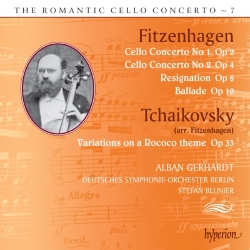
Wilhelm Fitzenhagen
Artist Info
Role:ComposerCountry: GermanyBirth:September 15, 1848Death:February 14, 1890Period:RomanticGenre:ChamberWilhelm Fitzenhagen was a German cellist and composer who lived from 1848 to 1890. He was born in Seesen, Germany, and showed an early aptitude for music. His father was a music teacher, and he began studying the cello with him at a young age. Fitzenhagen's talent was quickly recognized, and he was sent to study with the renowned cellist Friedrich Grützmacher in Dresden. Under Grützmacher's tutelage, Fitzenhagen developed into a virtuoso cellist. He made his debut as a soloist in 1866, and quickly gained a reputation as one of the finest cellists of his generation. He was appointed principal cellist of the Leipzig Gewandhaus Orchestra in 1873, a position he held until his death. In addition to his performing career, Fitzenhagen was also a prolific composer. He wrote a number of works for the cello, including concertos, sonatas, and chamber music. His music was influenced by the Romantic style of his time, and he was particularly interested in exploring the expressive possibilities of the cello. One of Fitzenhagen's most famous works is his Concert Waltz for cello and orchestra, Op. 31. This piece was written in 1879, and was dedicated to Fitzenhagen's wife, the pianist Marie Krebs. The Concert Waltz is a lively and virtuosic work, with a catchy melody and a sparkling orchestration. It has become a staple of the cello repertoire, and is still frequently performed today. Another notable work by Fitzenhagen is his Sonata for cello and piano, Op. 10. This piece was written in 1872, and is a fine example of Fitzenhagen's lyrical and expressive style. The Sonata is in three movements, and showcases the cello's range and versatility. It is a challenging work for both the cellist and the pianist, and is considered one of Fitzenhagen's most important compositions. Fitzenhagen also wrote a number of chamber music works, including a String Quartet in D minor, Op. 8. This piece was written in 1871, and is a powerful and dramatic work. It features a number of virtuosic passages for the cello, and demonstrates Fitzenhagen's skill as a composer of chamber music. Despite his success as a performer and composer, Fitzenhagen's life was not without its difficulties. He suffered from poor health throughout his career, and was forced to take extended breaks from performing and composing. He also struggled with financial difficulties, and was often forced to rely on the support of friends and colleagues. Fitzenhagen died in Moscow in 1890, at the age of 42. His legacy as a cellist and composer has endured, however, and his music continues to be performed and admired by musicians and audiences around the world.More....
Recent Artist Music
Copyright Ⓒ 2013 Davinci Finger. All rights reseved
Service Terms & Policy