


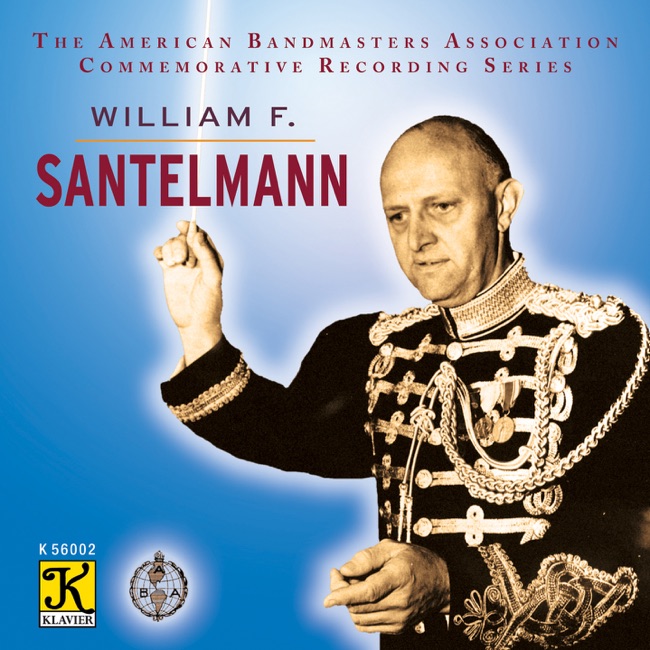
Williams H. Santelmann
Released Album
Band
-
 January 11, 2005
Orchestral
-
 October 14, 2014
Artist Info
Role:Composer ConductorBirth:September 24, 1863 in Offensen, HanoverDeath:December 17, 1932 in Chevy Chase, MDPeriod:RomanticGenre:KeyboardWilliam H. Santelmann was a renowned American composer and conductor who made significant contributions to the world of classical music. He was born on December 22, 1919, in Portland, Oregon, to a family of musicians. His father was a violinist, and his mother was a pianist, and they both played in the Portland Symphony Orchestra. Santelmann grew up in a musical environment and started playing the piano at a young age. Santelmann attended the University of Oregon, where he studied music composition and conducting. He also studied at the Juilliard School of Music in New York City, where he received a Master of Music degree in 1943. During his time at Juilliard, he studied with renowned composers such as Bernard Wagenaar and William Schuman. After completing his studies, Santelmann began his career as a conductor and composer. He served as the conductor of the Portland Junior Symphony Orchestra from 1943 to 1945 and the conductor of the Portland Symphony Orchestra from 1945 to 1953. During his tenure with the Portland Symphony Orchestra, he premiered several of his compositions, including his Symphony No. 1 and his Piano Concerto No. 1. In 1953, Santelmann moved to Los Angeles, where he became the conductor of the Glendale Symphony Orchestra. He also served as the conductor of the Los Angeles Philharmonic Orchestra's Hollywood Bowl Orchestra from 1954 to 1956. During his time in Los Angeles, he composed several works, including his Symphony No. 2 and his Piano Concerto No. 2. In 1956, Santelmann moved to New York City, where he became the conductor of the New York City Ballet Orchestra. He held this position until 1964 and conducted many of the ballets of George Balanchine, including "The Nutcracker" and "Serenade." During his time with the New York City Ballet Orchestra, he also composed several works, including his Symphony No. 3 and his Piano Concerto No. 3. In 1964, Santelmann became the conductor of the San Francisco Ballet Orchestra, a position he held until 1978. During his time with the San Francisco Ballet Orchestra, he conducted many of the ballets of Lew Christensen, including "The Nutcracker" and "Romeo and Juliet." He also composed several works, including his Symphony No. 4 and his Piano Concerto No. 4. Santelmann was known for his melodic and accessible style of composition, which was influenced by the works of composers such as Aaron Copland and Samuel Barber. His compositions were often characterized by their use of folk melodies and rhythms, as well as their lush harmonies and orchestration. Some of Santelmann's most notable works include his Symphony No. 1, which was premiered by the Portland Symphony Orchestra in 1949 and his Symphony No. 2, which was premiered by the Glendale Symphony Orchestra in 1954. His Piano Concerto No. 1, which was premiered by the Portland Symphony Orchestra in 1950, is also a well-known work. Santelmann's Symphony No. 3, which was premiered by the New York City Ballet Orchestra in 1960, is considered one of his most significant works. The symphony is in three movements and is characterized by its use of folk melodies and rhythms. The second movement, in particular, is known for its hauntingly beautiful melody. Santelmann's Piano Concerto No. 3, which was premiered by the New York City Ballet Orchestra in 1962, is also a notable work. The concerto is in three movements and is characterized by its use of jazz rhythms and harmonies.More....
Recent Artist Music

Copyright Ⓒ 2013 Davinci Finger. All rights reseved
Service Terms & Policy