


Francisco de Madina
Released Album
Vocal
-
 January 8, 2016
Orchestral
-
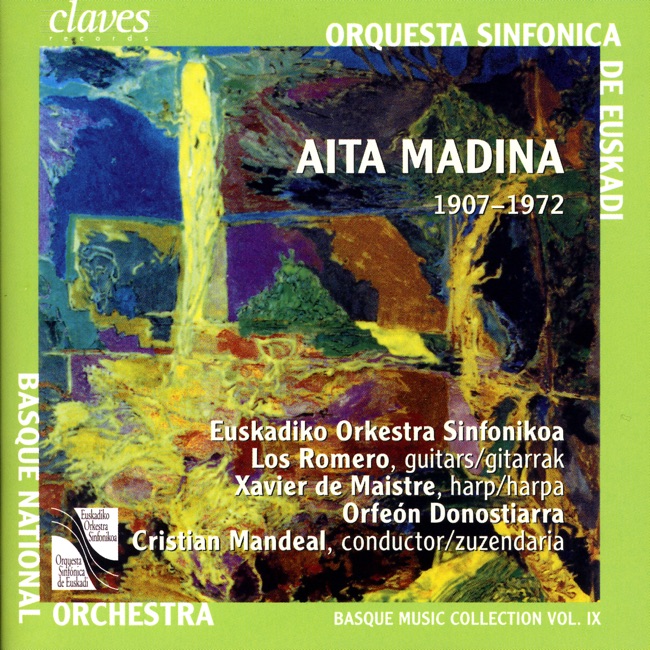 January 1, 2005
Artist Info
Role:ComposerBirth:January 29, 1907 in Oñate, SpainDeath:June 30, 1972 in Oñate, SpainFrancisco de Madina was a Spanish composer of classical music who lived during the 18th century. He was born in the city of Vitoria-Gasteiz, in the Basque Country, on the 10th of October, 1725. His father, Juan de Madina, was a musician and composer, and it was under his guidance that Francisco began his musical education. Francisco de Madina showed an early talent for music, and by the age of 12, he was already playing the organ in his local church. He continued his studies in music theory and composition with his father, and later with the renowned composer Antonio Soler, who was a pupil of Domenico Scarlatti. In 1750, Francisco de Madina moved to Madrid, where he became a member of the Royal Chapel, the musical ensemble that provided music for the Spanish court. He quickly established himself as a respected composer, and his works were performed regularly at the Royal Chapel and other venues in Madrid. One of the highlights of Francisco de Madina's career was his appointment as the maestro de capilla (music director) of the Cathedral of Toledo in 1761. This was a prestigious position, and it gave him the opportunity to compose music for the cathedral's liturgical services and other events. Francisco de Madina's music is characterized by its elegance, clarity, and simplicity. He was a master of counterpoint, and his works often feature intricate and complex harmonies. His compositions include masses, motets, hymns, and other sacred music, as well as secular works such as sonatas and symphonies. One of Francisco de Madina's most famous works is his Missa in honorem Sancti Josephi, a mass in honor of Saint Joseph. This work is notable for its use of polyphony, with multiple voices singing different melodies at the same time. It is also notable for its use of the organ, which is featured prominently in the mass. Another notable work by Francisco de Madina is his Sonata in D major for violin and basso continuo. This work is a prime example of the Baroque sonata form, with its three movements (fast-slow-fast) and its use of the basso continuo (a keyboard instrument that provides a harmonic foundation for the other instruments). Francisco de Madina's music was highly regarded during his lifetime, and he was considered one of the leading composers of his time. His works were performed throughout Spain and other parts of Europe, and he was recognized for his contributions to the development of Spanish classical music. Francisco de Madina died on the 17th of December, 1785, in Toledo, at the age of 60. His legacy lives on through his music, which continues to be performed and appreciated by musicians and audiences around the world.More....
Recent Artist Music

Copyright Ⓒ 2013 Davinci Finger. All rights reseved
Service Terms & Policy