


Grigorij Krein
Released Album
Keyboard
-
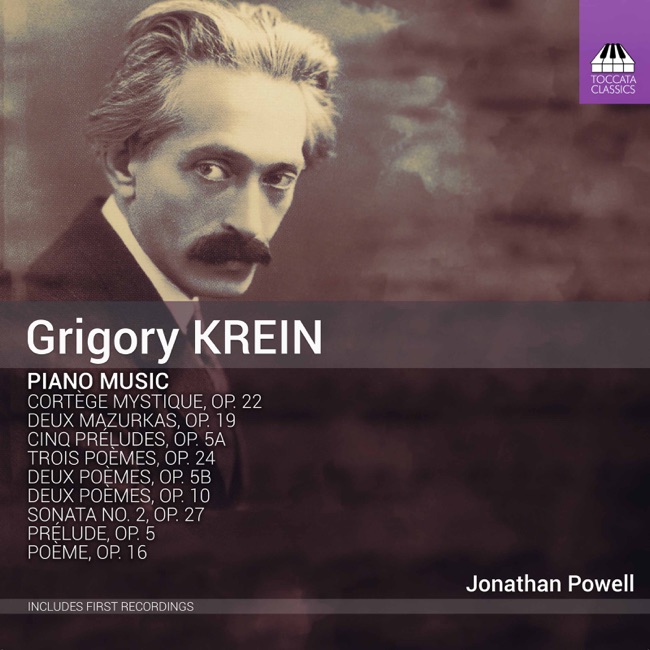 January 8, 2021
 -
 February 25, 2014
Artist Info
Role:ComposerBirth:1879Death:1957Grigorij Samuilovich Krein was a Russian composer and pianist who was born on August 15, 1879, in Nizhyn, Ukraine. He was born into a family of musicians, with his father being a violinist and his mother a pianist. Krein's musical talent was evident from a young age, and he began studying piano and composition with his mother at the age of five. Krein's family moved to Moscow when he was ten years old, and he continued his musical education at the Moscow Conservatory. He studied piano with Vasily Safonov and composition with Sergei Taneyev and Mikhail Ippolitov-Ivanov. Krein was a gifted student, and he won several awards and scholarships during his time at the conservatory. After graduating from the Moscow Conservatory in 1902, Krein began his career as a pianist and composer. He performed extensively throughout Russia and Europe, and his compositions were well-received by audiences and critics alike. Krein was known for his innovative approach to composition, blending elements of Russian folk music with Western classical music. One of Krein's most significant works is his Piano Concerto No. 1, which he composed in 1912. The concerto is a virtuosic showcase for the soloist, with intricate piano passages and lush orchestration. The work was premiered in Moscow in 1913, with Krein himself as the soloist. The concerto was a critical and commercial success, and it remains one of Krein's most popular works. Krein's output as a composer was diverse, encompassing orchestral works, chamber music, and vocal music. He was particularly interested in Jewish music, and he incorporated elements of Jewish folk music into many of his compositions. One of his most famous works in this vein is his Jewish Sketches, a suite for orchestra that features traditional Jewish melodies and rhythms. Krein's career was interrupted by the outbreak of World War I, and he served in the Russian army as a musician. After the war, he returned to Moscow and resumed his career as a composer and pianist. However, his life was upended again by the Russian Revolution of 1917. Krein was a Jew, and he faced persecution under the new Soviet regime. He was forced to flee Russia in 1921 and settled in Berlin. In Berlin, Krein continued to compose and perform, but he struggled to make a living. He was forced to take on odd jobs, including playing piano in a cinema and teaching music lessons. Despite these challenges, Krein continued to produce significant works, including his Symphony No. 1, which he composed in 1925. In 1933, Krein was forced to flee Germany due to the rise of the Nazi regime. He settled in Paris, where he lived for the rest of his life. In Paris, Krein continued to compose and perform, but he faced new challenges. He was a refugee, and he struggled to adapt to life in a new country. He also faced financial difficulties, as his music was not as well-known in France as it had been in Russia and Germany. Despite these challenges, Krein continued to produce significant works in Paris. One of his most famous works from this period is his Suite for Violin and Piano, which he composed in 1938. The suite is a virtuosic showcase for the violinist, with intricate melodies and complex rhythms. Krein's life was cut short by the outbreak of World War II. He died in Paris on January 17, 1944, at the age of 64. Despite his relatively short life, Krein left behind a significant body of work that continues to be performed and admired today.More....
Recent Artist Music

Copyright Ⓒ 2013 Davinci Finger. All rights reseved
Service Terms & Policy