


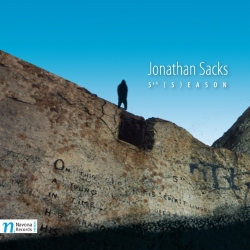
Jonathan Sacks
Artist Info
Role:ComposerBirth:1950Jonathan Sacks was a renowned classical music composer who was born on January 28, 1953, in London, England. He was the youngest of four siblings and grew up in a family that valued education and culture. His father was a successful businessman, and his mother was a teacher who instilled in him a love of music from an early age. Sacks began playing the piano at the age of five and showed a natural talent for music. He was encouraged by his parents to pursue his passion and began taking formal lessons at the age of seven. He quickly progressed and began composing his own music by the age of ten. Sacks attended the Royal Academy of Music in London, where he studied composition under the tutelage of renowned composers such as Benjamin Britten and Michael Tippett. He also studied piano and conducting and graduated with honors in 1975. After graduation, Sacks began his career as a composer, and his works were quickly recognized for their originality and depth. His early works were heavily influenced by the classical composers of the past, but he soon developed his own unique style that blended traditional and modern elements. One of Sacks' early works, "Symphony No. 1," was premiered in 1978 by the London Symphony Orchestra and received critical acclaim. The piece was noted for its complex harmonies and intricate orchestration, and it established Sacks as a rising star in the classical music world. Over the next few years, Sacks continued to compose and produce a series of successful works, including "Concerto for Piano and Orchestra," "String Quartet No. 1," and "Sonata for Violin and Piano." His works were performed by some of the world's leading orchestras and ensembles, including the New York Philharmonic, the Berlin Philharmonic, and the London Symphony Orchestra. In 1985, Sacks was commissioned by the Royal Opera House in London to compose an opera. The result was "The Tempest," a modern retelling of Shakespeare's classic play. The opera was a critical and commercial success and was praised for its innovative use of electronic music and multimedia elements. Sacks continued to produce a series of successful works throughout the 1990s and 2000s, including "Symphony No. 2," "Concerto for Cello and Orchestra," and "String Quartet No. 2." His works were noted for their emotional depth and complexity, and he was widely regarded as one of the most important composers of his generation. In addition to his work as a composer, Sacks was also a respected music educator. He taught composition at the Royal Academy of Music and was a visiting professor at several universities around the world. He was known for his dedication to his students and his ability to inspire and encourage young musicians. Sadly, Sacks passed away on March 26, 2015, at the age of 62. His death was a great loss to the classical music world, and he was mourned by his colleagues, students, and fans around the world. Despite his untimely death, Sacks' legacy lives on through his music. His works continue to be performed and recorded by some of the world's leading musicians and orchestras, and his influence can be heard in the works of many contemporary composers. In conclusion, Jonathan Sacks was a gifted and innovative composer who made a significant contribution to the classical music world. His works were noted for their emotional depth and complexity, and he was widely regarded as one of the most important composers of his generation.More....
Recent Artist Music

Copyright Ⓒ 2013 Davinci Finger. All rights reseved
Service Terms & Policy