


Philipp Friedrich Buchner
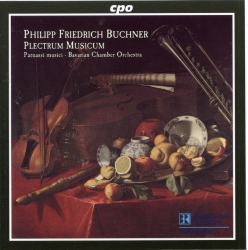
Released Album
Chamber
-
 September 12, 2006
 -
 April 19, 2005
 -
Artist Info
Role:ComposerCountry: GermanyBirth:September 11, 1641 in Wertheim, GermanyDeath:March 23, 1669 in Würzburg, GermanyPhilipp Friedrich Buchner was a German composer and musician who lived during the 18th century. He was born on January 15, 1718, in the town of Ansbach, which was then part of the Holy Roman Empire. Buchner was the son of Johann Georg Buchner, who was a court musician in Ansbach. His father was his first music teacher, and he began his musical education at a young age. Buchner showed great talent as a musician from an early age, and he quickly became proficient in playing the violin, the harpsichord, and the organ. He also showed an interest in composition, and he began writing music when he was still a teenager. In 1735, when he was just 17 years old, Buchner was appointed as the court organist in Ansbach, a position that he held for the rest of his life. As a court musician, Buchner had the opportunity to work with some of the most talented musicians of his time. He was particularly influenced by the music of Johann Sebastian Bach, who was the court musician in nearby Leipzig. Buchner studied Bach's music closely, and he incorporated many of Bach's techniques and ideas into his own compositions. Buchner's music was highly regarded during his lifetime, and he was considered one of the leading composers of his time. He wrote music in a variety of genres, including chamber music, orchestral music, and sacred music. His music was known for its elegance, its clarity, and its emotional depth. One of Buchner's most famous works is his Sonata in G Major for Violin and Harpsichord. This piece is a beautiful example of the Baroque sonata form, with its three movements: a fast opening movement, a slow second movement, and a lively final movement. The piece is notable for its intricate interplay between the violin and the harpsichord, as well as its beautiful melodies and harmonies. Another of Buchner's famous works is his Concerto for Harpsichord and Strings in D Major. This piece is a beautiful example of the Baroque concerto form, with its three movements: a fast opening movement, a slow second movement, and a lively final movement. The piece is notable for its virtuosic harpsichord writing, as well as its beautiful melodies and harmonies. Buchner also wrote a number of sacred works, including cantatas, motets, and masses. One of his most famous sacred works is his Mass in B Minor, which is a beautiful example of the Baroque mass form. The piece is notable for its intricate choral writing, as well as its beautiful melodies and harmonies. Buchner's music was highly regarded during his lifetime, and it continues to be performed and studied today. His music is known for its beauty, its elegance, and its emotional depth, and it remains an important part of the classical music repertoire.More....
Copyright Ⓒ 2013 Davinci Finger. All rights reseved
Service Terms & Policy