


Milosz Magin
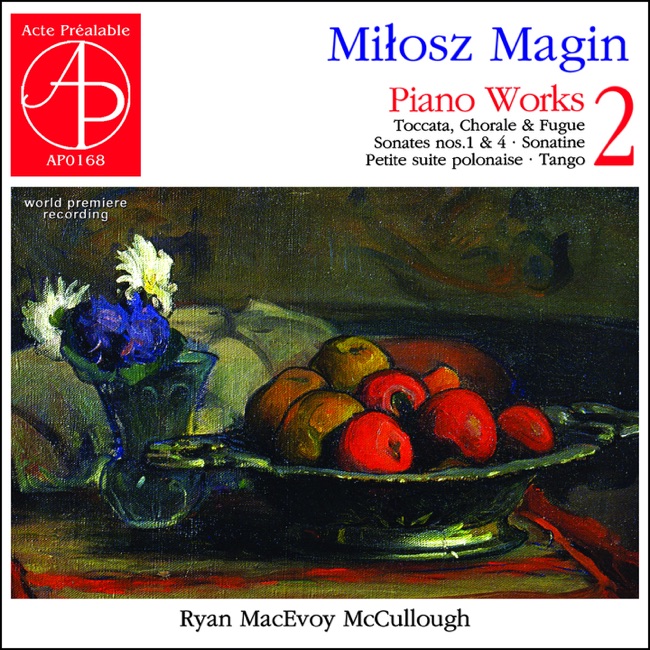

Artist Info
Role:ComposerCountry: PolandBirth:1929 in Lódz, PolandDeath:1999Period:ModernGenre:ConcertoKeyboardOrchestralSymphonyMilosz Magin was a Polish composer and pianist who was born on January 23, 1929, in Warsaw, Poland. He was the son of a well-known Polish composer, Boleslaw Magin, who was also a professor at the Warsaw Conservatory. Milosz grew up in a musical family and began playing the piano at a young age. He showed great talent and was soon recognized as a prodigy. Magin's musical education began at the Warsaw Conservatory, where he studied piano with Maria Wiłkomirska and composition with his father. He continued his studies at the State Higher School of Music in Warsaw, where he studied composition with Kazimierz Sikorski and piano with Zbigniew Drzewiecki. He graduated with honors in 1952. Magin's early compositions were influenced by the neoclassical style of Stravinsky and Hindemith. His first major work, the Piano Concerto No. 1, was premiered in 1951 and received critical acclaim. The concerto showcased Magin's virtuosic piano playing and his ability to blend traditional forms with modern harmonies. In 1953, Magin won the prestigious Chopin Prize for his Piano Sonata No. 1. The sonata was hailed as a masterpiece and established Magin as one of the leading composers of his generation. The work is characterized by its lyrical melodies, complex harmonies, and virtuosic piano writing. Magin's music continued to evolve throughout the 1950s and 1960s. He began to incorporate elements of Polish folk music into his compositions, as well as experimenting with serialism and aleatoric techniques. His Symphony No. 1, premiered in 1958, is a prime example of his use of folk music. The symphony is based on the traditional Polish song "Hej, hej, w dolinie" and features a solo violin playing a folk melody. Magin's output during the 1970s and 1980s was marked by a return to more traditional forms and a focus on chamber music. He wrote several string quartets, sonatas for various instruments, and a piano trio. His String Quartet No. 3, premiered in 1975, is considered one of his finest works. The quartet is characterized by its intricate counterpoint and use of chromaticism. Magin's final years were marked by a decline in health, and he died on December 17, 1999, in Warsaw. He left behind a legacy of over 100 compositions, including orchestral works, chamber music, and solo piano pieces. His music is characterized by its lyricism, virtuosity, and incorporation of Polish folk music. Magin's contributions to Polish music were recognized with numerous awards and honors. He was awarded the Order of Polonia Restituta, one of Poland's highest civilian honors, in 1974. He was also a member of the Polish Academy of Sciences and the Polish Composers' Union. In conclusion, Milosz Magin was a prolific and influential composer who left a lasting impact on Polish music. His compositions blended traditional forms with modern harmonies and incorporated elements of Polish folk music. His virtuosic piano writing and intricate counterpoint are hallmarks of his style. Magin's legacy continues to inspire and influence musicians today.More....
Recent Artist Music



Recommend Playlist









Copyright Ⓒ 2013 Davinci Finger. All rights reseved
Service Terms & Policy