


Emanuel Aloys Förster
Artist Info
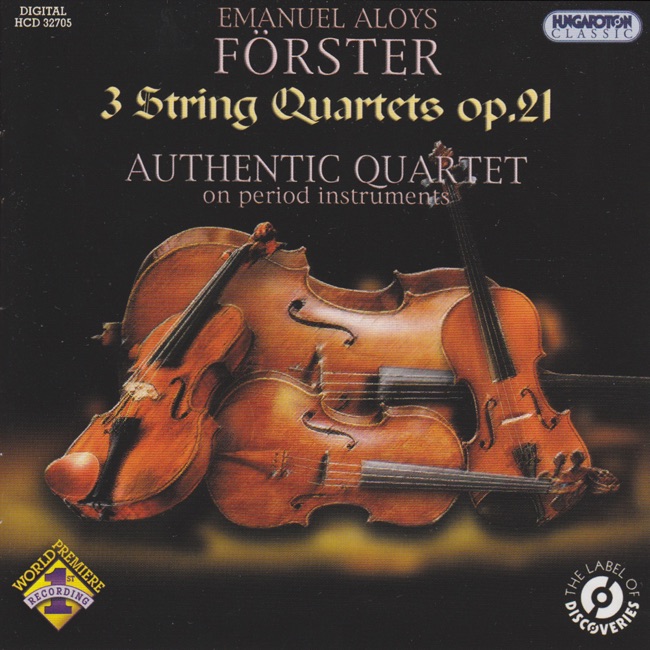
Role:ComposerCountry: AustriaBirth:January 26, 1748 in Niederstein bei Glatz, PrussiaDeath:November 12, 1823 in Vienna, AustriaGenre:KeyboardEmanuel Aloys Förster was a German composer and musician who lived during the 18th century. He was born on January 18, 1748, in the town of Murrhardt, which is located in the state of Baden-Württemberg in Germany. Förster was the son of a schoolteacher, and he showed an early interest in music. He began his musical education at a young age, studying the violin and keyboard with his father. Förster's talent as a musician was recognized early on, and he was sent to study music in Stuttgart. There, he studied with the composer Johann Christoph Oley, who was the court organist and a prominent figure in the musical life of the city. Förster quickly became one of Oley's star pupils, and he was soon performing in public concerts and composing his own music. In 1770, Förster moved to Mannheim, which was then one of the most important musical centers in Europe. There, he became a member of the famous Mannheim Court Orchestra, which was renowned for its virtuosity and innovative style. Förster played the violin in the orchestra, and he quickly became one of its most respected members. During his time in Mannheim, Förster also began to compose music in earnest. He wrote a number of symphonies, concertos, and chamber works, many of which were performed by the Mannheim Court Orchestra. Förster's music was characterized by its elegance, lyricism, and technical virtuosity. He was particularly skilled at writing for the violin, and his violin concertos were widely admired for their beauty and expressiveness. In 1778, Förster left Mannheim and moved to Paris, which was then the cultural capital of Europe. There, he quickly established himself as a leading figure in the city's musical life. He performed in public concerts, taught music to private students, and composed a great deal of music. Förster's music was well-received in Paris, and he was praised for his skill as a composer and performer. During his time in Paris, Förster wrote a number of important works, including his Symphony No. 1 in C major, his Violin Concerto No. 1 in D major, and his String Quartet No. 1 in G major. These works were characterized by their elegance, clarity, and technical virtuosity. They were also notable for their use of innovative musical techniques, such as the use of chromaticism and the development of new forms and structures. In 1784, Förster left Paris and returned to Germany. He settled in the city of Frankfurt, where he continued to compose music and teach music to private students. Förster's music continued to be well-received, and he was regarded as one of the leading composers of his time. During his later years, Förster's health began to decline, and he was forced to retire from public life. He continued to compose music, however, and he wrote a number of important works during this time. These included his Symphony No. 2 in D major, his Violin Concerto No. 2 in A major, and his String Quartet No. 2 in E-flat major. Emanuel Aloys Förster died on June 10, 1823, in Frankfurt. He was 75 years old. Förster's legacy as a composer and musician has endured to this day. His music is still performed and recorded by musicians around the world, and he is regarded as one of the most important composers of the classical period. His works are characterized by their elegance, lyricism, and technical virtuosity, and they continue to be admired for their beauty and expressiveness.More....
Recent Artist Music
1
4:50
Copyright Ⓒ 2013 Davinci Finger. All rights reseved
Service Terms & Policy