


François Rossé
Released Album
Chamber
-
 May 8, 2018
 -
 February 10, 2015
 -
-
 July 8, 2014
 -
 April 8, 2014
 -
 November 12, 2013
Artist Info
Role:ComposerGenre:Avant-GardeChamberFrançois Rossé is a French composer who was born on December 14, 1945, in Besançon, France. He grew up in a family of musicians, with his father being a violinist and his mother a pianist. Rossé began his musical education at a young age, studying piano and music theory. He later went on to study composition at the Conservatoire de Paris, where he was a student of Olivier Messiaen. Rossé's early works were heavily influenced by the avant-garde movement of the 1960s and 1970s. He was particularly interested in the use of electronic music and the incorporation of non-traditional instruments into classical compositions. His early works include "Mécanique" (1969), "L'Énergie du désespoir" (1971), and "Le Chant des ténèbres" (1973). In the 1980s, Rossé began to incorporate more traditional elements into his compositions. He began to use more conventional instruments, such as the piano and the violin, and his works became more tonal. This shift in style can be heard in works such as "Le Tombeau de Ravel" (1987) and "Le Tombeau de Debussy" (1988). One of Rossé's most significant works is "Le Livre des Claviers" (1990-1995), a cycle of 24 pieces for piano. The work is inspired by the preludes and fugues of J.S. Bach's "The Well-Tempered Clavier" and is divided into two books. The first book is based on the 12 major keys, while the second book is based on the 12 minor keys. Each piece in the cycle is a study in a particular musical technique or form, such as counterpoint, canon, or variation. Rossé's interest in electronic music continued throughout his career, and he has composed several works that incorporate electronic elements. One of his most notable works in this genre is "Le Chant des Oiseaux" (1998), a piece for flute, clarinet, violin, cello, and electronics. The work is inspired by the songs of birds and features recordings of bird calls that are manipulated and processed electronically. In addition to his work as a composer, Rossé has also been active as a teacher and conductor. He has taught composition at several institutions, including the Conservatoire de Paris and the University of California, San Diego. He has also conducted several orchestras, including the Orchestre National de France and the San Diego Symphony. Rossé's music has been performed by many notable musicians and ensembles, including the Arditti Quartet, the Ensemble Intercontemporain, and the Orchestre Philharmonique de Radio France. He has received numerous awards and honors for his work, including the Prix de Rome and the Grand Prix de la Ville de Paris. In conclusion, François Rossé is a French composer who has had a significant impact on the world of classical music. His early works were heavily influenced by the avant-garde movement, while his later works incorporated more traditional elements. His cycle of 24 pieces for piano, "Le Livre des Claviers," is one of his most significant works, and he has also been active in the field of electronic music. Rossé's music has been performed by many notable musicians and ensembles, and he has received numerous awards and honors for his work.More....
Recent Artist Music
3
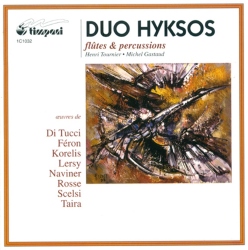
For a Grain of Sand from the East
Für ein Sandkörnchen von Osten, für G-Flöte, Marimba, Vibraphon und Schlagzeug
13:20
Copyright Ⓒ 2013 Davinci Finger. All rights reseved
Service Terms & Policy