


Johann Rufinatscha
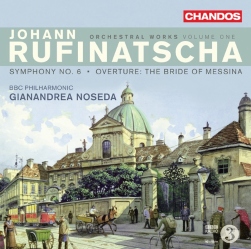
Released Album
Orchestral

Artist Info
Role:ComposerBirth:October 1, 1812 in Mals, AustriaDeath:May 25, 1893Period:RomanticJohann Rufinatscha was a classical music composer born on January 2, 1812, in the town of Rankweil, Austria. He was the son of a schoolteacher and showed an early interest in music. At the age of six, he began taking piano lessons and later studied violin and composition. Rufinatscha's musical talent was recognized early on, and he was sent to study at the Vienna Conservatory at the age of 14. There, he studied under some of the most prominent composers of the time, including Ignaz von Seyfried and Simon Sechter. He also became friends with Franz Schubert, who was a frequent visitor to the conservatory. After completing his studies, Rufinatscha worked as a music teacher and conductor in various cities throughout Austria. In 1840, he was appointed the conductor of the Graz Opera, where he remained for several years. During this time, he also composed a number of works, including his Symphony No. 1 in C minor, which was well-received by audiences and critics alike. In 1846, Rufinatscha moved to Innsbruck, where he became the conductor of the local orchestra. He also continued to compose, and his Symphony No. 2 in E-flat major was premiered in Innsbruck in 1848. This work was also well-received and helped to establish Rufinatscha's reputation as a composer. Throughout his career, Rufinatscha composed a wide variety of works, including symphonies, chamber music, and operas. His music was characterized by its lyricism and emotional depth, and he was known for his skillful use of orchestration. One of Rufinatscha's most famous works is his Symphony No. 3 in D minor, which was composed in 1851. This work is notable for its dramatic intensity and its use of folk melodies. It was premiered in Innsbruck in 1852 and was later performed in Vienna and other cities throughout Europe. Rufinatscha's other notable works include his String Quartet No. 1 in E-flat major, his Piano Trio in G minor, and his opera Der Waffenschmied. He also composed a number of choral works, including his Mass in C major and his Te Deum. Despite his talent and success as a composer, Rufinatscha struggled with financial difficulties throughout his life. He was often forced to take on teaching and conducting jobs to make ends meet, and he never achieved the level of fame and recognition that some of his contemporaries did. Rufinatscha died on November 6, 1893, in Innsbruck. Although he is not as well-known as some of his contemporaries, his music continues to be performed and appreciated by classical music enthusiasts around the world. His contributions to the classical music canon are significant, and his works remain a testament to his talent and dedication to his craft.More....
Recent Artist Music
Copyright Ⓒ 2013 Davinci Finger. All rights reseved
Service Terms & Policy