


Peter Michael Hamel
Released Album
Keyboard
-
 January 23, 1992
Orchestral
-
 November 6, 2001
Choral
-
 January 27, 2004
Artist Info
Role:ComposerCountry: GermanyBirth:July 15, 1947Genre:OrchestralPeter Michael Hamel is a German composer, born on July 15, 1947, in Munich, Germany. He is known for his contributions to the field of contemporary classical music, particularly in the areas of minimalism and electronic music. Hamel's music is characterized by its meditative and spiritual qualities, often incorporating elements of Eastern philosophy and mysticism. Hamel began his musical education at a young age, studying piano and composition at the Munich Conservatory. He later went on to study musicology and philosophy at the University of Munich, where he was introduced to the works of Eastern philosophers such as Lao Tzu and Confucius. These influences would go on to shape his musical style and approach to composition. In the early 1970s, Hamel became involved with the German avant-garde music scene, collaborating with artists such as Terry Riley and La Monte Young. He also began experimenting with electronic music, incorporating synthesizers and other electronic instruments into his compositions. This experimentation led to the creation of his seminal work, "The Voice of Silence," which was released in 1973. "The Voice of Silence" is a minimalist composition that features a single sustained chord played on an organ, accompanied by a series of electronic drones and overtones. The piece is intended to be listened to in a meditative state, with the sustained chord serving as a focal point for the listener's attention. The work was highly influential in the development of minimalist music, and has been cited as an inspiration by artists such as Brian Eno and Steve Reich. Throughout the 1970s and 1980s, Hamel continued to explore the intersection of Eastern philosophy and contemporary classical music. He released a series of albums that incorporated elements of Indian classical music, such as "Nada" (1977) and "Bardo" (1981). These works feature intricate rhythms and melodic structures, as well as the use of traditional Indian instruments such as the sitar and tabla. In the 1990s, Hamel began to incorporate more overtly spiritual themes into his music. His album "Colors of Time" (1992) features a series of compositions inspired by the writings of the Sufi mystic Rumi. The album features a mix of acoustic and electronic instruments, as well as the use of spoken word and vocal chants. Hamel's later works have continued to explore the themes of spirituality and meditation. His album "Transition" (2003) features a series of compositions that are intended to be listened to in a state of deep relaxation. The album incorporates elements of ambient music and features the use of Tibetan singing bowls and other traditional instruments. In addition to his work as a composer, Hamel has also been involved in music education. He has taught at the Hochschule für Musik und Theater Hamburg and the University of Music and Performing Arts Munich, and has written several books on music theory and composition. Overall, Peter Michael Hamel's contributions to contemporary classical music have been significant. His exploration of Eastern philosophy and spirituality has led to the creation of a unique and meditative musical style that has influenced countless artists in the field of minimalism and electronic music. His work continues to be celebrated and studied by musicians and music lovers around the world.More....
Recent Artist Music
2
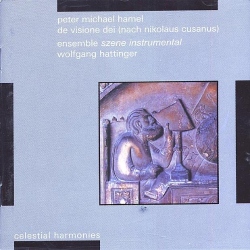
De visione Dei, a church music theater for organ, wind and percussion instruments
In silentio contemplationis (Im Schweigen der Betrachtung)
7:19
Copyright Ⓒ 2013 Davinci Finger. All rights reseved
Service Terms & Policy