


Ivan Karabits
Released Album
Concerto
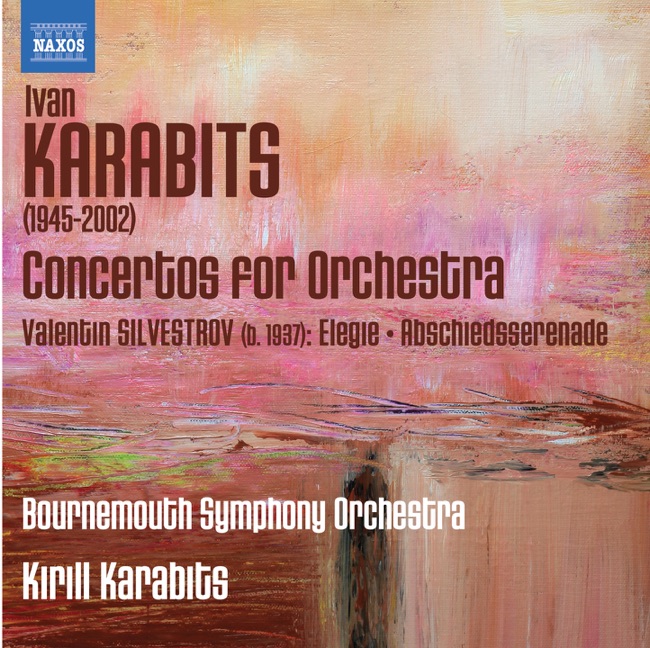
Chamber
-
 February 12, 2016
Artist Info
Role:ComposerBirth:1945Death:2002Ivan Karabits was a Ukrainian composer and conductor who made significant contributions to the world of classical music. Born on January 22, 1945, in Lviv, Ukraine, Karabits grew up in a family of musicians. His father, Petro Karabits, was a renowned conductor, and his mother, Nadiya Karabits, was a pianist. From a young age, Karabits showed a keen interest in music and began studying the piano and violin. Karabits received his formal music education at the Lviv Conservatory, where he studied composition under the tutelage of Adam Soltys. He graduated with honors in 1968 and went on to pursue a career in music. In 1971, he became the conductor of the Lviv Philharmonic Orchestra, a position he held for six years. During this time, he also worked as a professor of composition at the Lviv Conservatory. Karabits' early compositions were heavily influenced by the works of Ukrainian composers such as Mykola Lysenko and Borys Lyatoshynsky. His music was characterized by its use of folk melodies and rhythms, as well as its incorporation of modernist techniques. Some of his early works include the Symphony No. 1 (1968), the Concerto for Violin and Orchestra (1970), and the String Quartet No. 1 (1972). In 1977, Karabits moved to Kyiv, where he became the conductor of the National Symphony Orchestra of Ukraine. He held this position for over a decade and helped to establish the orchestra as one of the leading ensembles in the country. During his tenure, he conducted numerous premieres of works by Ukrainian composers, as well as works by international composers such as Gustav Mahler and Dmitri Shostakovich. Karabits' compositions from this period continued to explore the intersection of Ukrainian folk music and modernist techniques. His Symphony No. 2 (1980) and Symphony No. 3 (1984) both incorporate Ukrainian folk melodies and rhythms, while also incorporating elements of serialism and atonality. His Concerto for Piano and Orchestra (1982) is similarly characterized by its use of folk melodies and its incorporation of modernist techniques. In addition to his work as a composer and conductor, Karabits was also a dedicated teacher. He taught composition at the Kyiv Conservatory from 1980 to 1990 and at the Tchaikovsky National Music Academy of Ukraine from 1990 until his death. Many of his students went on to become successful composers and performers in their own right. Karabits' later compositions continued to explore the intersection of Ukrainian folk music and modernist techniques, but also showed a greater interest in spirituality and mysticism. His Symphony No. 4 (1990) is a meditation on the theme of death and features a hauntingly beautiful choral section. His Symphony No. 5 (1995) is similarly meditative, with a focus on the theme of rebirth and renewal. Karabits' final composition, the Symphony No. 6 (2002), was left unfinished at the time of his death. The work was completed by his son, Kirill Karabits, who is also a conductor and composer. The Symphony No. 6 is a deeply personal work that reflects on the composer's own mortality and the legacy he hoped to leave behind. Ivan Karabits died on February 2, 2002, at the age of 57. He left behind a rich legacy of compositions and recordings, as well as a lasting impact on the Ukrainian music scene. His works continue to be performed and recorded by orchestras and ensembles around the world, and his influence can be heard in the works of many contemporary Ukrainian composers.More....
Recent Artist Music


Copyright Ⓒ 2013 Davinci Finger. All rights reseved
Service Terms & Policy