


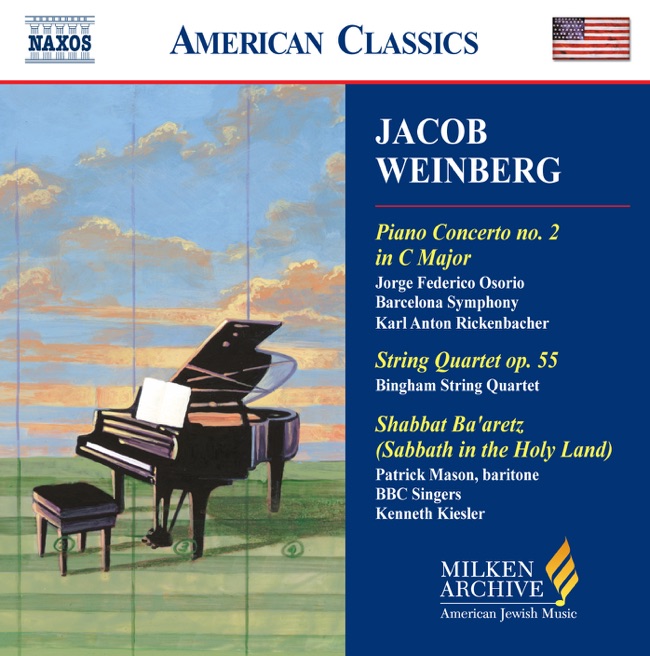
Jacob Weinberg
Released Album
Chamber
Concerto
-
 September 23, 2003
Artist Info
Role:ComposerBirth:1879Death:1956Genre:ChamberConcertoJacob Weinberg was a classical music composer born on August 12, 1879, in Odessa, Ukraine. He was born into a family of musicians, and his father was a cantor in the local synagogue. Weinberg's musical talent was evident from a young age, and he began studying piano and composition at the age of six. In 1893, Weinberg's family moved to the United States, settling in New York City. There, Weinberg continued his musical studies, studying with renowned composers such as Rubin Goldmark and Percy Goetschius. He also began performing as a pianist, and his talent quickly gained recognition. In 1906, Weinberg moved to Paris to further his musical education. There, he studied with Vincent d'Indy and Charles-Marie Widor, two of the most prominent composers of the time. Weinberg's time in Paris was a formative period in his career, and he was heavily influenced by the French impressionist style of music. After returning to the United States in 1910, Weinberg began composing in earnest. His early works were heavily influenced by the French impressionist style, but he soon began to develop his own unique voice. Weinberg's music was characterized by its lush harmonies, intricate counterpoint, and expressive melodies. One of Weinberg's most significant works is his Symphony No. 2, which he composed in 1917. The symphony is a powerful and emotional work, with a sweeping, cinematic quality. It was well-received by critics and helped establish Weinberg as one of the leading composers of his time. Weinberg continued to compose throughout the 1920s and 1930s, producing a wide range of works in various genres. He wrote operas, ballets, chamber music, and choral works, among other things. One of his most notable works from this period is his opera The Golden Peacock, which premiered in 1927. The opera is a colorful and exotic work, with a lush score that draws on Weinberg's love of Eastern European folk music. In the 1940s, Weinberg's career took a turn for the worse. He struggled to find work as a composer, and his music fell out of favor with audiences and critics. Despite this, he continued to compose, producing a number of works that are now considered among his finest. One of Weinberg's most significant works from this period is his Symphony No. 5, which he composed in 1945. The symphony is a powerful and emotional work, with a hauntingly beautiful second movement that is widely regarded as one of Weinberg's greatest achievements. Weinberg continued to compose throughout the 1950s and 1960s, but his health began to decline. He suffered a stroke in 1963, which left him partially paralyzed and unable to compose. He died on April 8, 1967, at the age of 87. Today, Weinberg is remembered as one of the most important composers of the early 20th century. His music is characterized by its emotional depth, lush harmonies, and expressive melodies. Despite the challenges he faced in his later years, Weinberg remained committed to his art, producing a body of work that continues to inspire and move audiences today.More....
Recent Artist Music
1

2:38
5
2:38
Copyright Ⓒ 2013 Davinci Finger. All rights reseved
Service Terms & Policy