


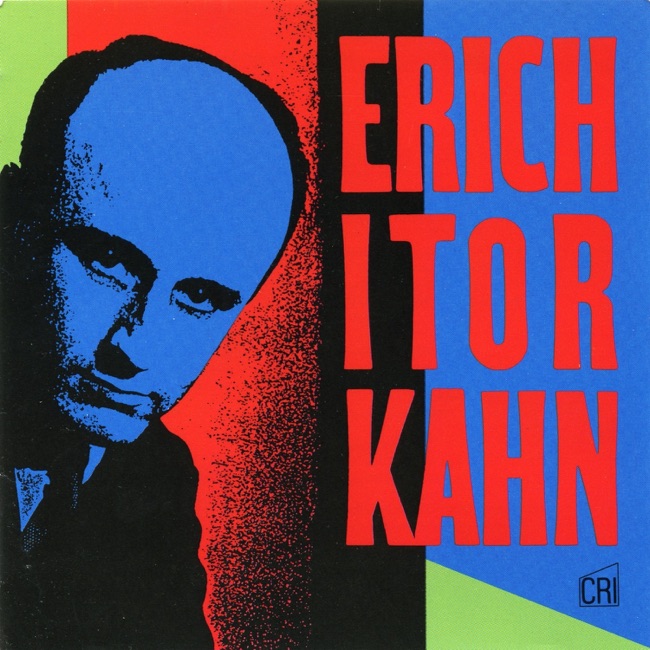
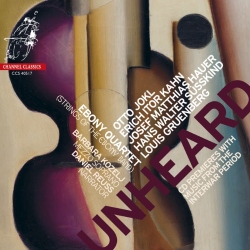
Erich Itor Kahn
Released Album
Choral

Vocal
-
 April 20, 1994
Artist Info
Role:ComposerBirth:July 23, 1905Death:March 5, 1956Period:ModernGenre:ChamberConcertoKeyboardVocalErich Itor Kahn was a German-American composer, conductor, and music theorist who made significant contributions to the development of modernist music in the early 20th century. Born on March 10, 1905, in Hamburg, Germany, Kahn was the son of a wealthy Jewish family. His father was a successful businessman, and his mother was a talented pianist who encouraged her son's interest in music from an early age. Kahn began his formal music education at the age of six, studying piano with his mother and later with the renowned pianist and composer Ferruccio Busoni. He also studied composition with Arnold Schoenberg, who was a major influence on his musical style. In 1922, Kahn enrolled at the Hochschule für Musik in Berlin, where he studied conducting with Fritz Busch and composition with Paul Juon. In 1924, Kahn made his debut as a conductor with the Berlin Philharmonic Orchestra, leading a performance of his own composition, "Symphony No. 1." The performance was well-received, and Kahn quickly established himself as a rising star in the classical music world. Over the next few years, he conducted many of the leading orchestras in Europe, including the Vienna Philharmonic, the London Symphony Orchestra, and the Paris Opera Orchestra. In 1929, Kahn moved to the United States, where he became a professor of music at the University of California, Los Angeles. He continued to compose and conduct, and his works were performed by many of the leading orchestras in the United States, including the New York Philharmonic and the Boston Symphony Orchestra. Kahn's music was characterized by its modernist style, which incorporated elements of atonality, polytonality, and serialism. His compositions were often complex and challenging, but they were also highly expressive and emotional. Some of his most famous works include "Symphony No. 2," "String Quartet No. 2," and "Piano Sonata No. 2." In addition to his work as a composer and conductor, Kahn was also a respected music theorist. He wrote several influential books on music theory, including "Counterpoint" and "Harmony." His theories on music were highly influential in the development of modernist music, and they continue to be studied and discussed by music scholars today. Throughout his career, Kahn received many awards and honors for his contributions to classical music. In 1950, he was awarded the Pulitzer Prize for Music for his composition, "Piano Concerto No. 2." He was also awarded the Guggenheim Fellowship in 1952 and the National Institute of Arts and Letters Award in 1960. Despite his many accomplishments, Kahn's life was not without its challenges. As a Jewish musician living in Germany during the rise of the Nazi party, he faced persecution and discrimination. In 1933, he was forced to flee Germany and emigrate to the United States. He also faced challenges in his personal life, including a difficult marriage and struggles with depression. Despite these challenges, Kahn continued to create and innovate throughout his life. He remained an active composer and conductor until his death in 1956 at the age of 51. Today, he is remembered as one of the most important figures in the development of modernist music, and his contributions to classical music continue to be celebrated and studied by musicians and scholars around the world.More....
Recent Artist Music
2

Cantata no. 114, "Ah, dear Christians, be of good cheer", BWV 114
2. Aria. Wo wird in diesem Jammertale
9:18
3

3:14
5

Cantata no. 202, "Depart, afflicted shadows" "Wedding Cantata", BWV 202
Weichet nur, betrübte Schatten
6:29
6
Cantata no. 116, "You free prince, Lord Jesus Christ", BWV 116
Ach, unaussprechlich ist die Not
4:47
Copyright Ⓒ 2013 Davinci Finger. All rights reseved
Service Terms & Policy